
Vibepedia

Complex Systems: The Unseen Architects of Reality | Vibepedia

Interdisciplinary Emergent Phenomena Network Theory
Complex Systems: The Unseen Architects of Reality | Vibepedia

Complex systems are the fundamental building blocks of our universe, from the intricate dance of subatomic particles to the sprawling networks of global…

Contents

  1. 🌐 What Exactly Are Complex Systems?
  2. 🧠 The Brain & The Cosmos: Scale of Complexity
  3. 💡 Key Concepts: Emergence & Feedback Loops
  4. 📈 Why Study Them? Real-World Impact
  5. 🔬 How to Approach Complex Systems
  6. 📚 Further Exploration: Essential Reading
  7. 🗣️ Debates & Controversies
  8. 🚀 The Future of Complex Systems Research
  9. Frequently Asked Questions
  10. Related Topics

Overview

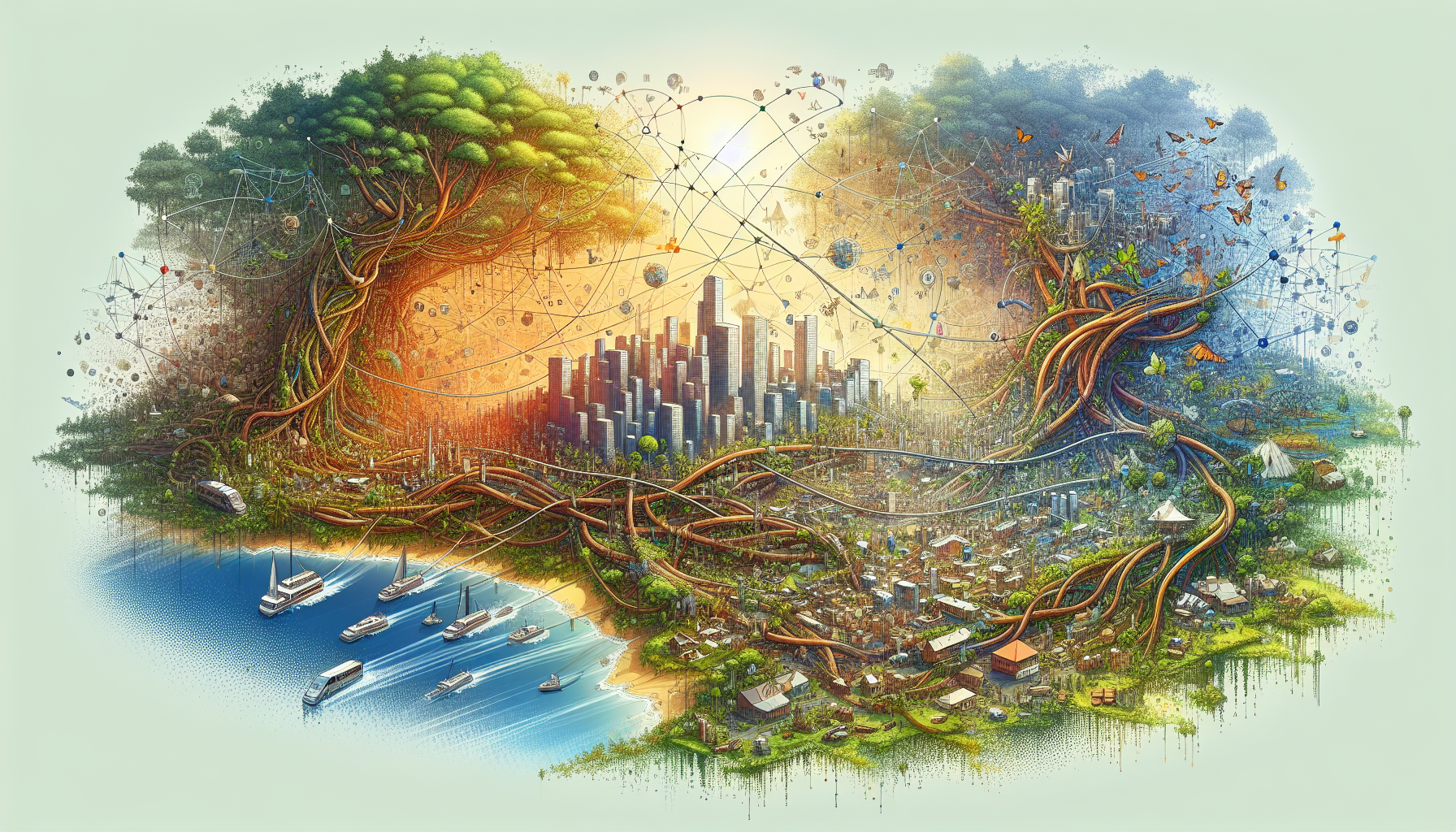
Complex systems are not just collections of parts; they are intricate webs of interacting components where the whole is decidedly more than the sum of its parts. Think of a flock of birds: no single bird dictates the flock's movement, yet a stunningly coordinated aerial ballet emerges from simple, local interactions. This principle applies across scales, from the microscopic dance of Protein Interactions within a Cellular Biology to the macroscopic ballet of Climate Science. Understanding these systems requires moving beyond reductionist thinking to embrace interconnectedness and dynamic behavior. They are the unseen architects shaping everything from your Urban Planning to the very Evolutionary Biology.

🧠 The Brain & The Cosmos: Scale of Complexity

The sheer scale of complex systems is mind-boggling, spanning from the Neuroscience with its estimated 86 billion neurons, each forming thousands of connections, to the Cosmology itself, a vast network of galaxies and cosmic structures. The Internet Infrastructure, a relatively recent but profoundly complex system, connects billions of devices and people, demonstrating how interconnectedness can rapidly accelerate information flow and societal change. Even seemingly simple entities like an Ecology are complex systems, with intricate food webs and environmental feedback loops that maintain delicate balances. The challenge lies in mapping these vast interdependencies and understanding their emergent properties.

💡 Key Concepts: Emergence & Feedback Loops

At the heart of complex systems theory lie two fundamental concepts: Emergence (Complex Systems) and Feedback Loops. Emergence describes how novel properties and behaviors arise from the interactions of simpler components, properties that cannot be predicted by examining the components in isolation. Think of consciousness arising from neural activity or traffic jams forming from individual driver decisions. Feedback loops, whether Positive Feedback (amplifying change) or Negative Feedback (stabilizing change), are the dynamic engines driving system behavior, pushing them towards equilibrium or sometimes into chaotic states. These mechanisms are crucial for understanding system resilience and vulnerability.

📈 Why Study Them? Real-World Impact

Studying complex systems is not an academic exercise; it's a practical necessity for navigating our increasingly interconnected world. From designing more resilient Energy Systems to understanding the spread of Epidemiology, the insights gained are invaluable. Economists use complex systems models to predict market crashes, urban planners to alleviate Traffic Flow, and ecologists to manage Resource Management. The ability to anticipate, adapt to, and even design for the emergent behaviors of these systems is a critical skill for the 21st century, impacting everything from Public Health Policy to Financial Systems.

🔬 How to Approach Complex Systems

Approaching complex systems requires a shift in perspective. Instead of dissecting components, focus on the relationships and interactions between them. Employing Agent-Based Modeling allows researchers to simulate the behavior of individual agents (like people or cells) and observe the emergent system-level patterns. Network analysis helps visualize and quantify the connections within a system, revealing critical nodes and pathways. Understanding Nonlinear Dynamics is also key, as small changes in initial conditions can lead to vastly different outcomes, a hallmark of chaotic behavior in systems like Meteorology.

📚 Further Exploration: Essential Reading

For those eager to delve deeper, several foundational texts and resources are indispensable. James Gleick's "Chaos: Making a New Science" (1987) offers a compelling narrative of the early days of chaos theory and its connection to complex systems. Murray Gell-Mann's "The Quark and the Jaguar"(1994) provides a physicist's perspective on complexity. More contemporary works like Melanie Mitchell's "Complexity: A Guided Tour"(2009) offer accessible introductions. For a more technical understanding, exploring resources on Network Science and Computational Modeling is highly recommended. Vibepedia itself offers a growing knowledge graph mapping these interconnected ideas.

🗣️ Debates & Controversies

The study of complex systems is not without its debates. A central tension lies in the tension between Predictability in Complex Systems. While we can identify patterns and understand mechanisms like feedback loops, the sheer number of interacting variables and the potential for Butterfly Effect (the 'butterfly effect') often make precise long-term prediction impossible. Another debate centers on the Reductionism vs. Holism in scientific inquiry; while reductionism has yielded immense progress, complex systems theory champions a more holistic view, sometimes leading to friction with traditional scientific methodologies. The very definition of 'complexity' itself remains a subject of ongoing discussion.

🚀 The Future of Complex Systems Research

The future of complex systems research is bright and increasingly integrated. We're moving towards more sophisticated computational models capable of simulating larger and more intricate systems, from Supply Chain Management to the Microbiome Research. The application of Artificial Intelligence and Machine Learning to analyze complex data sets will unlock new insights into emergent behaviors. Expect to see greater interdisciplinary collaboration, as fields like Sociology, Biology, and Engineering increasingly adopt complex systems frameworks to tackle grand challenges like Climate Change Adaptation and Sustainable Development Goals. The quest to understand the unseen architects of reality is accelerating.

Key Facts

Year
Mid-20th Century (formalization)
Origin
Santa Fe Institute, Cybernetics, General Systems Theory
Category
Science & Philosophy
Type
Concept

Frequently Asked Questions

What's the difference between a complicated system and a complex system?

A complicated system, like a jet engine, has many parts, but they are designed to work in predictable ways and can often be understood by analyzing each component. A complex system, like a rainforest ecosystem or the stock market, has many interacting parts whose behavior is often non-linear and emergent. You can't fully predict the system's behavior by just looking at its individual components; the interactions are key, and the system can adapt and change in ways that weren't explicitly designed.

Can complex systems be controlled?

Direct control is often difficult, if not impossible, due to their inherent non-linearity and emergent properties. Instead of direct control, the focus is often on influencing or guiding complex systems. This might involve adjusting parameters, introducing interventions, or creating conditions that favor desired emergent behaviors. Think of nudging rather than commanding. For example, policymakers might implement incentives to steer economic behavior rather than dictating specific outcomes.

What are some everyday examples of complex systems?

Many aspects of daily life are complex systems. Your Urban Planning involves interactions between drivers, traffic signals, road infrastructure, and weather. The Internet Infrastructure is a massive complex system of interconnected devices and networks. Even a Social Dynamics can be viewed as a complex system, with individuals interacting based on personalities, relationships, and the environment, leading to emergent group dynamics.

Is 'complexity' a measurable quantity?

Defining and measuring 'complexity' is an ongoing challenge in the field. There isn't one single, universally agreed-upon metric. Researchers use various approaches, such as measuring the number of components, the density of interactions, the unpredictability of behavior, or the computational resources needed to describe the system. Different measures are useful for different types of complex systems and research questions.

How does complex systems theory relate to artificial intelligence?

There's a strong and growing relationship. Many AI techniques, particularly in Machine Learning and Deep Learning, are designed to find patterns and make predictions within vast, complex datasets. Concepts from complex systems, like emergent behavior and feedback loops, help explain how sophisticated AI models can achieve capabilities that weren't explicitly programmed. Conversely, AI tools are increasingly used to model and analyze complex systems themselves.

Are complex systems always chaotic?

No, not all complex systems are chaotic, though chaos is a common characteristic. A system can be complex due to a large number of interacting parts and emergent properties without necessarily exhibiting chaotic behavior (extreme sensitivity to initial conditions). Many complex systems operate in a state of 'edge of chaos,' balancing between order and randomness, which is often considered optimal for adaptability and information processing. Other complex systems might be relatively stable or exhibit predictable cycles.