
Contents
Overview
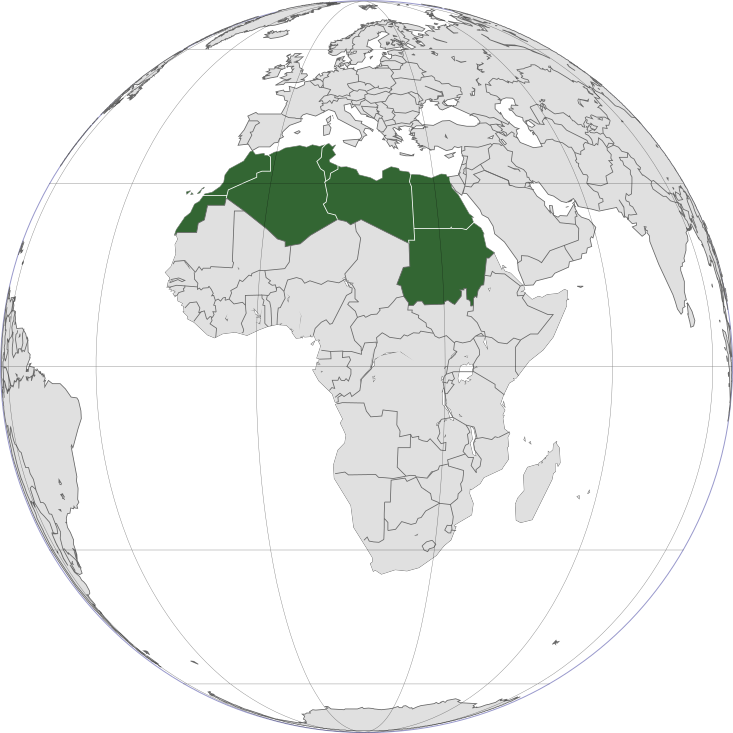
North Africa, a region stretching from the Atlantic to the Red Sea, is a geopolitical crucible shaped by its strategic location, rich history, and diverse populations. Historically a crossroads for trade and empires, from Phoenicians and Romans to Ottomans and French colonialists, its modern landscape is defined by the interplay of internal dynamics and external influences. Key players like Algeria, Morocco, Tunisia, Libya, and Egypt navigate complex relationships with global powers such as the European Union, Russia, and China, all vying for influence over energy resources, migration routes, and regional stability. The region grapples with internal challenges including political transitions, economic disparities, and security threats, making its geopolitical trajectory a critical factor in global affairs. The ongoing dispute over Western Sahara, the legacy of the Arab Spring, and the management of trans-Saharan migration routes are just a few of the flashpoints that underscore the region's volatile yet vital significance.
🎵 Origins & History
The geopolitical narrative of North Africa is etched in millennia of history, a constant flux of empires and trade routes. From the ancient Phoenician colonies and the Roman dominion that cemented Mediterranean control, to the Arab conquests that introduced Islam and Arabic language, the region has always been a bridge and a battleground. The Ottoman era saw a complex web of local rulers and imperial oversight, which was later fractured by European colonial ambitions in the 19th and 20th centuries. French dominance in Algeria, Tunisia, and Morocco, British influence in Egypt, and Italian presence in Libya left indelible marks on borders, economies, and political systems. Post-colonial independence in the mid-20th century ushered in new regional dynamics, often characterized by pan-Arabism, Cold War alignments, and the emergence of distinct national identities, setting the stage for the complex geopolitical landscape of today.
⚙️ How It Works
North Africa's geopolitics functions through a multi-layered system of state-to-state relations, regional blocs, and external power interventions. The Maghreb Union (AMU), though often hampered by bilateral disputes, represents a formal framework for regional cooperation, primarily between Algeria and Morocco. However, the region's strategic importance extends far beyond these internal dynamics. The proximity to Europe makes migration control and trade a constant point of negotiation with the EU. Meanwhile, the presence of significant hydrocarbon reserves in Algeria and Libya attracts energy-hungry powers like Russia and China, who seek to secure supply lines and expand their economic and political footprints. Security cooperation, particularly in counter-terrorism efforts, also draws in external actors like the United States, creating a complex geopolitical chessboard.
📊 Key Facts & Numbers
North Africa's geopolitical significance is underscored by staggering figures. The region encompasses over 6 million square kilometers, home to more than 250 million people. Its exclusive economic zones in the Mediterranean hold an estimated 10% of the world's proven natural gas reserves and significant oil deposits, with Algeria alone accounting for approximately 1.5% of global oil production. The Strait of Gibraltar, a vital maritime chokepoint, sees over 300 ships pass daily. In 2023, remittances from North African migrants abroad, primarily in Europe, exceeded $30 billion, highlighting the critical role of diaspora populations. The region also serves as a primary transit point for hundreds of thousands of irregular migrants annually attempting to reach Europe, a flow that directly impacts European border policies and international relations.
👥 Key People & Organizations
Key actors shaping North African geopolitics include national governments, regional organizations, and international powers. Within the region, the presidencies of Algeria and Morocco are central, often at odds over territorial disputes like Western Sahara. Egypt, with its pivotal role in the Suez Canal and regional security, wields considerable influence. International players like the EU, through its Neighborhood Policy and financial aid, and France, with its historical ties and continued economic interests, are major external forces. Russia and China are increasingly assertive, particularly through energy deals and infrastructure investments, while the United States maintains a security presence and diplomatic engagement, notably through its Africa Command (AFRICOM). Regional bodies like the Arab League and the African Union also play roles in mediating disputes and setting agendas.
🌍 Cultural Impact & Influence
The cultural resonance of North Africa is profound, influencing art, literature, and global perceptions. Its historical position as a nexus of Berber, Arab, African, and European cultures has fostered a rich tapestry of traditions, languages, and cuisines. This cultural exchange has been a constant theme in literature, from Albert Camus's Algerian-set novels to contemporary North African writers exploring identity and post-colonialism. The region's music, from Rai in Algeria to Gnawa in Morocco, has gained international acclaim, influencing global genres. Furthermore, North Africa's role as a gateway for migration to Europe has indelibly shaped cultural narratives and public discourse on both continents, prompting ongoing dialogues about identity, belonging, and intercultural relations.
⚡ Current State & Latest Developments
The current geopolitical landscape of North Africa is marked by several critical developments. The protracted dispute over Western Sahara remains a significant point of contention, with Morocco asserting control and the Polisario Front advocating for independence. Libya continues to navigate a complex post-conflict environment, with competing governments and external powers supporting different factions, impacting regional stability. Egypt is focused on internal economic reforms and its role in regional security, particularly concerning the Eastern Mediterranean and the Horn of Africa. Algeria and Morocco are engaged in a strategic rivalry, influencing regional alliances and trade dynamics. Meanwhile, the ongoing flow of migrants across the Sahara and the Mediterranean remains a persistent challenge, driving diplomatic efforts and security cooperation with European partners.
🤔 Controversies & Debates
North Africa is a hotbed of geopolitical controversies. The most prominent is the Western Sahara conflict, a decades-long dispute over sovereignty that has stalled regional integration and led to accusations of human rights abuses. The legacy of Arab Spring uprisings continues to fuel debate about democratic transitions versus authoritarian resilience, particularly in Egypt and Tunisia. The management of migration routes is another major point of contention, with accusations of human rights violations by state and non-state actors, and ongoing disagreements between North African nations and the EU over responsibility and border control. Furthermore, the influence of external powers, especially Russia and China, and their impact on regional sovereignty and economic dependencies, is a subject of intense debate among analysts and policymakers.
🔮 Future Outlook & Predictions
The future of North African geopolitics hinges on several key trends. The resolution, or continued stalemate, of the Western Sahara conflict will significantly impact regional integration and stability. The ongoing political and economic evolution of Libya will continue to shape security dynamics. The growing influence of China through its Belt and Road Initiative projects, particularly in infrastructure and energy, is likely to reshape economic dependencies and geopolitical alignments. The management of climate change impacts, including water scarcity and desertification, will increasingly drive internal and external policy. Furthermore, the evolving relationship between North Africa and the EU, particularly concerning migration and energy security, will remain a defining feature of the region's geopolitical future.
💡 Practical Applications
The practical applications of understanding North African geopolitics are far-reaching. For energy companies, knowledge of regional stability, resource distribution, and political risk is crucial for investment decisions in oil and gas exploration and infrastructure, particularly in Algeria and Libya. For governments, particularly in Europe, understanding migration patterns, border security, and potential spillover effects from regional conflicts is vital for national security and policy formulation. International organizations rely on this understanding to design effective aid programs, counter-terrorism strategies, and diplomatic interventions. Businesses seeking to expand into the region must grasp the complex regulatory environments, trade agreements, and political relationships that govern market acces
Key Facts
- Category
- geopolitics
- Type
- topic