
Contents
Overview
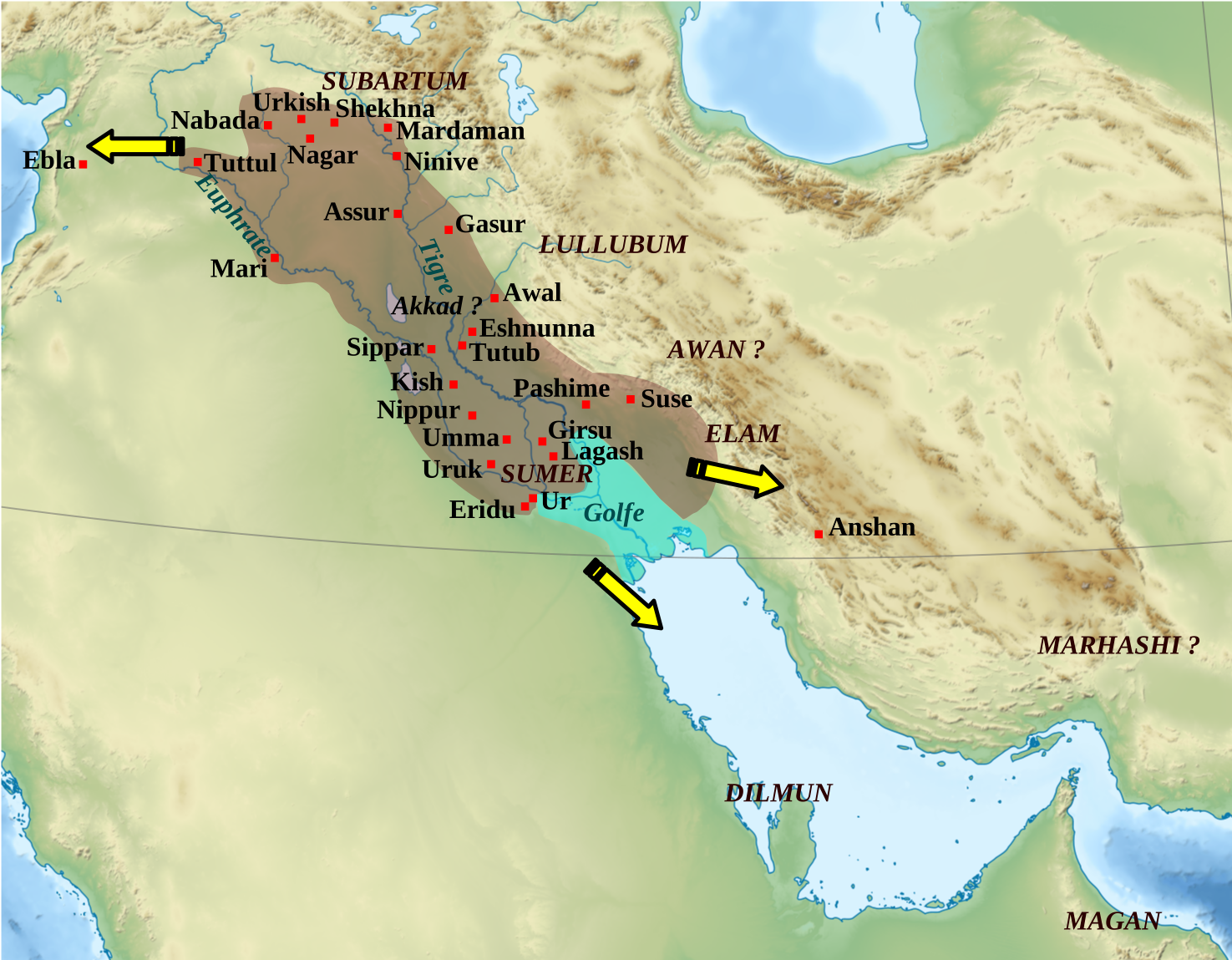
The genesis of the Akkadian Empire is inextricably linked to the ambition of Sargon of Akkad, a figure whose origins are shrouded in legend, often described as a gardener or cupbearer who rose to power. Sargon of Akkad achieved a feat previously unimaginable: he conquered the powerful Sumerian city-states, including Ur and Lagash, defeating their king, Lugal-zage-si, and dismantling their independent rule. This act of unification, replacing a fragmented landscape of city-states with a single imperial entity, marked a profound shift in Mesopotamian political organization. Sargon established his capital at Akkad, a city whose precise location remains a subject of scholarly debate, and his dynasty, the First Dynasty of Akkad, would rule for over a century, expanding the empire's reach through military campaigns that extended to Anatolia and the Persian Gulf.
⚙️ How It Worked
The Akkadian Empire operated on a model of centralized administration that was revolutionary for its time. Sargon and his successors implemented standardized weights and measures, a unified legal system, and a sophisticated bureaucracy to manage their vast territories. They appointed Akkadian governors to oversee conquered cities, ensuring loyalty and efficient tax collection, thereby undermining local power structures. The empire's military was a formidable force, employing disciplined infantry and chariots, which enabled them to project power across vast distances and suppress rebellions. Furthermore, the empire fostered trade networks, facilitating the exchange of goods and ideas between Mesopotamia and distant lands like Magan and Dilmun, enriching its economy and cultural landscape.
📊 Key Facts & Numbers
The Akkadian Empire spanned a significant geographical area, estimated to have covered approximately 800,000 square kilometers at its zenith. Its reign lasted for roughly 210 years, from its founding in 2334 BCE to its collapse around 2154 BCE. The empire controlled an estimated population of several million people, a substantial number for the ancient world. The military campaigns of Sargon and his successors are documented through numerous inscriptions, with some accounts suggesting armies of up to 5,400 soldiers. The empire's economic output was significant, with tribute and taxes flowing into the capital from at least 15 major cities and numerous smaller settlements across its domain. The Akkadian language, a Semitic tongue, gradually supplanted Sumerian as the lingua franca, with estimates suggesting over 90% of administrative texts by the late Akkadian period were written in Akkadian.
👥 Key People & Organizations
The central figure of the Akkadian Empire is undoubtedly Sargon of Akkad, its founder, whose military genius and administrative acumen laid the empire's foundation. His successors, including his sons Rimush and Manishtushu, and most notably his grandson Naram-Sin, played crucial roles in consolidating and expanding the empire. Naram-Sin, in particular, elevated himself to divine status, a significant departure from previous rulers, and faced numerous challenges, including invasions by the Gutians and Lullubi. The empire's administrative structure relied on a network of governors and scribes, many of whom are known from cuneiform tablets, though their individual names are often lost to history. The city of Akkad itself, though its exact location is unknown, served as the administrative and cultural heart of this vast dominion.
🌍 Cultural Impact & Influence
The Akkadian Empire left an indelible mark on the cultural and political trajectory of the ancient Near East. It pioneered the concept of a multi-ethnic, centralized empire, a model that would be emulated by subsequent powers such as the Neo-Babylonian Empire and the Persian Empire. The spread of the Akkadian language as a diplomatic and administrative tongue facilitated communication and cultural exchange across a wide region, influencing the development of other Semitic languages. Akkadian literature, including myths and epics, preserved and transmitted Sumerian traditions while also developing its own distinct narratives. The empire's artistic achievements, particularly in sculpture and cylinder seals, showcased a new realism and dynamism, exemplified by the Victory Stele of Naram-Sin, which depicted the king as a divine ruler.
⚡ Current State & Latest Developments
The physical remnants of the Akkadian Empire are scattered across modern-day Iraq and surrounding regions, with archaeological sites like Tell Brak and Mari yielding significant Akkadian-period artifacts. While the capital city of Akkad remains elusive, archaeological excavations continue to uncover administrative centers, palaces, and temples from the Akkadian era, providing a clearer picture of its urban planning and societal structure. Ongoing research focuses on deciphering newly discovered cuneiform tablets, which offer fresh insights into the empire's economy, legal practices, and religious beliefs. The study of Akkadian administrative techniques and military organization continues to inform our understanding of early state formation and imperial expansion.
🤔 Controversies & Debates
One of the most persistent debates surrounding the Akkadian Empire concerns its collapse. While traditional narratives often attribute its downfall to internal rebellion and external invasions, particularly by the Gutians, recent scholarship suggests a more complex picture involving environmental factors. Some researchers propose that a severe, multi-century drought, potentially triggered by climate shifts around 2150 BCE, may have devastated agricultural production, leading to widespread famine, social unrest, and the eventual disintegration of the empire's centralized authority. The extent to which Sargon's successors were truly divine rulers, as Naram-Sin proclaimed, is also debated, with some scholars viewing it as a political maneuver to consolidate power rather than a widespread religious belief. The very existence and precise location of the capital city, Akkad, remain a point of contention among archaeologists and historians.
🔮 Future Outlook & Predictions
The legacy of the Akkadian Empire suggests that future research will likely continue to refine our understanding of its collapse and the environmental factors that may have contributed to it. Advances in paleoclimatology could provide more precise data on ancient droughts and their impact on Mesopotamian societies. Furthermore, ongoing archaeological work in regions previously under Akkadian influence may uncover new evidence of its administrative reach and cultural impact, potentially revealing previously unknown cities or administrative centers. The study of Akkadian military strategies and logistical capabilities could also offer lessons for understanding ancient warfare and imperial projection, while comparative studies with later empires like the Roman Empire will continue to highlight the enduring patterns of imperial rise and fall.
💡 Practical Applications
The Akkadian Empire's innovations in administration, law, and military organization served as foundational elements for subsequent Mesopotamian civilizations. The standardized weights and measures developed by the Akkadians were adopted and adapted by the Babylonians and Assyrians, facilitating trade and economic stability across the region for millennia. Their legal codes, though not as extensively preserved as later ones like the Code of Hammurabi, established precedents for codified law and justice. The empire's military structure and tactics influenced the development of warfare in the ancient Near East, with concepts of centralized command and disciplined troop formations proving effective. The spread of Akkadian as a lingua franca also laid the groundwork for later imperial languages, demonstrating the power of a dominant culture to shape communication across diverse populations.
Key Facts
- Category
- history
- Type
- topic