
Contents
- 🎵 Origins & History
- ⚙️ How It Works
- 📊 Key Facts & Numbers
- 👥 Key People & Organizations
- 🌍 Cultural Impact & Influence
- ⚡ Current State & Latest Developments
- 🤔 Controversies & Debates
- 🔮 Future Outlook & Predictions
- 💡 Practical Applications
- 📚 Related Topics & Deeper Reading
- Frequently Asked Questions
- References
- Related Topics
Overview
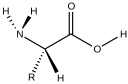
Amino acids are organic compounds that contain both amino and carboxylic acid functional groups, with 22 α-amino acids being the most important for their incorporation into proteins. These compounds play a crucial role in various biological processes, including neurotransmitter transport and biosynthesis, and are thought to have enabled life on Earth. With over 500 amino acids existing in nature, they can be classified according to their core structural functional groups, polarity, ionization, and side-chain group type. Amino acids are formally named by the IUPAC-IUBMB Joint Commission on Biochemical Nomenclature, and their study has led to significant advancements in fields such as biochemistry, molecular biology, and genetics. The importance of amino acids is further highlighted by their role in the production of proteins, which are essential for the structure and function of all living organisms, including humans. The study of amino acids has also been influenced by the work of scientists such as Linus Pauling and Francis Crick, who have contributed to our understanding of the structure and function of DNA and proteins.
🎵 Origins & History
The discovery of amino acids dates back to the early 19th century, when Justus von Liebig first isolated glycine from gelatin. Since then, numerous scientists have contributed to the understanding of amino acids, including Emil Fischer, who was awarded the Nobel Prize in Chemistry in 1902 for his work on sugar and purine metabolism. The development of chromatography and mass spectrometry has enabled the identification and quantification of amino acids in various biological samples, including blood and tissue samples. The study of amino acids has also been influenced by the work of scientists such as Robert Cores, who has made significant contributions to the field of biochemistry.
⚙️ How It Works
Amino acids are characterized by the presence of both amino and carboxylic acid functional groups, which are attached to a central carbon atom. The 22 α-amino acids that are incorporated into proteins can be classified into several categories, including essential amino acids, non-essential amino acids, and conditionally essential amino acids. The structure and properties of amino acids are influenced by the presence of various side chains, which can be polar, nonpolar, aromatic, or charged. The study of amino acid structure and function has been facilitated by the development of molecular modeling and computational biology tools, such as PyMOL and Rosetta.
📊 Key Facts & Numbers
There are over 500 amino acids that exist in nature, although only 22 are incorporated into proteins. The most abundant amino acids in nature are glycine, alanine, and glutamic acid. Amino acids can be synthesized through various methods, including fermentation and chemical synthesis. The production of amino acids is a significant industry, with companies such as Ajinomoto and Evonik producing large quantities of amino acids for use in food, pharmaceuticals, and animal feed. The use of amino acids in biotechnology has also led to the development of new products and technologies, such as genetic engineering and gene therapy.
👥 Key People & Organizations
Several key people have contributed to the understanding of amino acids, including Linus Pauling, who was awarded the Nobel Prize in Chemistry in 1954 for his work on the structure of proteins. Other notable scientists include Francis Crick, who, along with James Watson, discovered the structure of DNA, and Marshall Nirenberg, who deciphered the genetic code. Organizations such as the National Institutes of Health and the American Chemical Society have also played a significant role in promoting research and education in the field of amino acids. The work of these scientists and organizations has been influenced by the development of new technologies, such as next-generation sequencing and CRISPR.
🌍 Cultural Impact & Influence
Amino acids have had a significant impact on culture and society, particularly in the fields of medicine and nutrition. The discovery of essential amino acids has led to the development of infant formula and other nutritional products. Amino acids have also been used in the production of cosmetics and pharmaceuticals. The study of amino acids has also been influenced by the work of scientists such as Elizabeth Blackburn, who has made significant contributions to the field of telomere research. The cultural impact of amino acids is also reflected in the development of new products and technologies, such as personalized medicine and gene editing.
⚡ Current State & Latest Developments
Currently, research is focused on the development of new methods for the synthesis and analysis of amino acids, as well as their applications in biotechnology and medicine. The use of amino acids in cancer therapy and gene therapy is also being explored. Companies such as Novartis and Pfizer are investing heavily in research and development in these areas. The study of amino acids is also being influenced by the development of new technologies, such as artificial intelligence and machine learning.
🤔 Controversies & Debates
There are several controversies and debates surrounding amino acids, including the use of genetically modified organisms in the production of amino acids. Some scientists have also raised concerns about the potential health effects of consuming high levels of certain amino acids, such as homocysteine. The use of amino acids in sports supplements has also been the subject of controversy, with some athletes being banned for using performance-enhancing substances. The debate surrounding amino acids is also reflected in the development of new regulations and guidelines, such as the FDA regulations on the use of amino acids in food and pharmaceuticals.
🔮 Future Outlook & Predictions
The future outlook for amino acids is promising, with ongoing research and development in the fields of biotechnology and medicine. The use of amino acids in personalized medicine and gene editing is expected to increase, and new applications in cosmetics and pharmaceuticals are being explored. The study of amino acids is also expected to be influenced by the development of new technologies, such as synthetic biology and genome editing.
💡 Practical Applications
Amino acids have a wide range of practical applications, including their use in food, pharmaceuticals, and cosmetics. They are also used in biotechnology and medicine, particularly in the production of proteins and peptides. The use of amino acids in animal feed and fertilizers is also significant. The study of amino acids has also led to the development of new products and technologies, such as biofuels and bioplastics.
Key Facts
- Year
- 2022
- Origin
- Earth
- Category
- science
- Type
- concept
Frequently Asked Questions
What are amino acids?
Amino acids are organic compounds that contain both amino and carboxylic acid functional groups. They are the building blocks of proteins and have various biological functions. Amino acids can be classified into several categories, including essential amino acids, non-essential amino acids, and conditionally essential amino acids. The study of amino acids has been influenced by the work of scientists such as Linus Pauling and Francis Crick.
How many amino acids exist in nature?
There are over 500 amino acids that exist in nature, although only 22 are incorporated into proteins. The most abundant amino acids in nature are glycine, alanine, and glutamic acid. Amino acids can be synthesized through various methods, including fermentation and chemical synthesis. The production of amino acids is a significant industry, with companies such as Ajinomoto and Evonik producing large quantities of amino acids for use in food, pharmaceuticals, and animal feed.
What are the applications of amino acids?
Amino acids have a wide range of practical applications, including their use in food, pharmaceuticals, and cosmetics. They are also used in biotechnology and medicine, particularly in the production of proteins and peptides. The use of amino acids in animal feed and fertilizers is also significant. The study of amino acids has also led to the development of new products and technologies, such as biofuels and bioplastics.
Who are some notable scientists who have contributed to the understanding of amino acids?
Several notable scientists have contributed to the understanding of amino acids, including Linus Pauling, Francis Crick, and Marshall Nirenberg. These scientists have made significant contributions to the field of biochemistry and have been recognized with numerous awards, including the Nobel Prize in Chemistry. The work of these scientists has been influenced by the development of new technologies, such as next-generation sequencing and CRISPR.
What are some of the controversies surrounding amino acids?
There are several controversies surrounding amino acids, including the use of genetically modified organisms in amino acid production. Some scientists have also raised concerns about the potential health effects of consuming high levels of certain amino acids, such as homocysteine. The use of amino acids in sports supplements has also been the subject of controversy, with some athletes being banned for using performance-enhancing substances. The debate surrounding amino acids is also reflected in the development of new regulations and guidelines, such as the FDA regulations on the use of amino acids in food and pharmaceuticals.
What is the future outlook for amino acids?
The future outlook for amino acids is promising, with ongoing research and development in the fields of biotechnology and medicine. The use of amino acids in personalized medicine and gene editing is expected to increase, and new applications in cosmetics and pharmaceuticals are being explored. The study of amino acids is also expected to be influenced by the development of new technologies, such as synthetic biology and genome editing.
How do amino acids relate to other topics?
Amino acids are related to several other topics, including proteins, enzymes, and metabolism. The study of amino acids has also been influenced by the development of new technologies, such as next-generation sequencing and CRISPR. Other related topics include genetics, molecular biology, and biochemistry. The study of amino acids is also reflected in the development of new fields, such as synthetic biology and systems biology.