
Contents
- 🎵 Origins & History
- ⚙️ How It Worked: Governance and Society
- 📊 Key Facts & Numbers
- 👥 Key Dynasties & Emperors
- 🌍 Cultural Impact & Influence
- ⚡ The End of an Era: Decline and Fall
- 🤔 Controversies & Debates
- 🔮 Future Outlook & Legacy
- 💡 Practical Applications (of Imperial Systems)
- 📚 Related Topics & Deeper Reading
- References
Overview
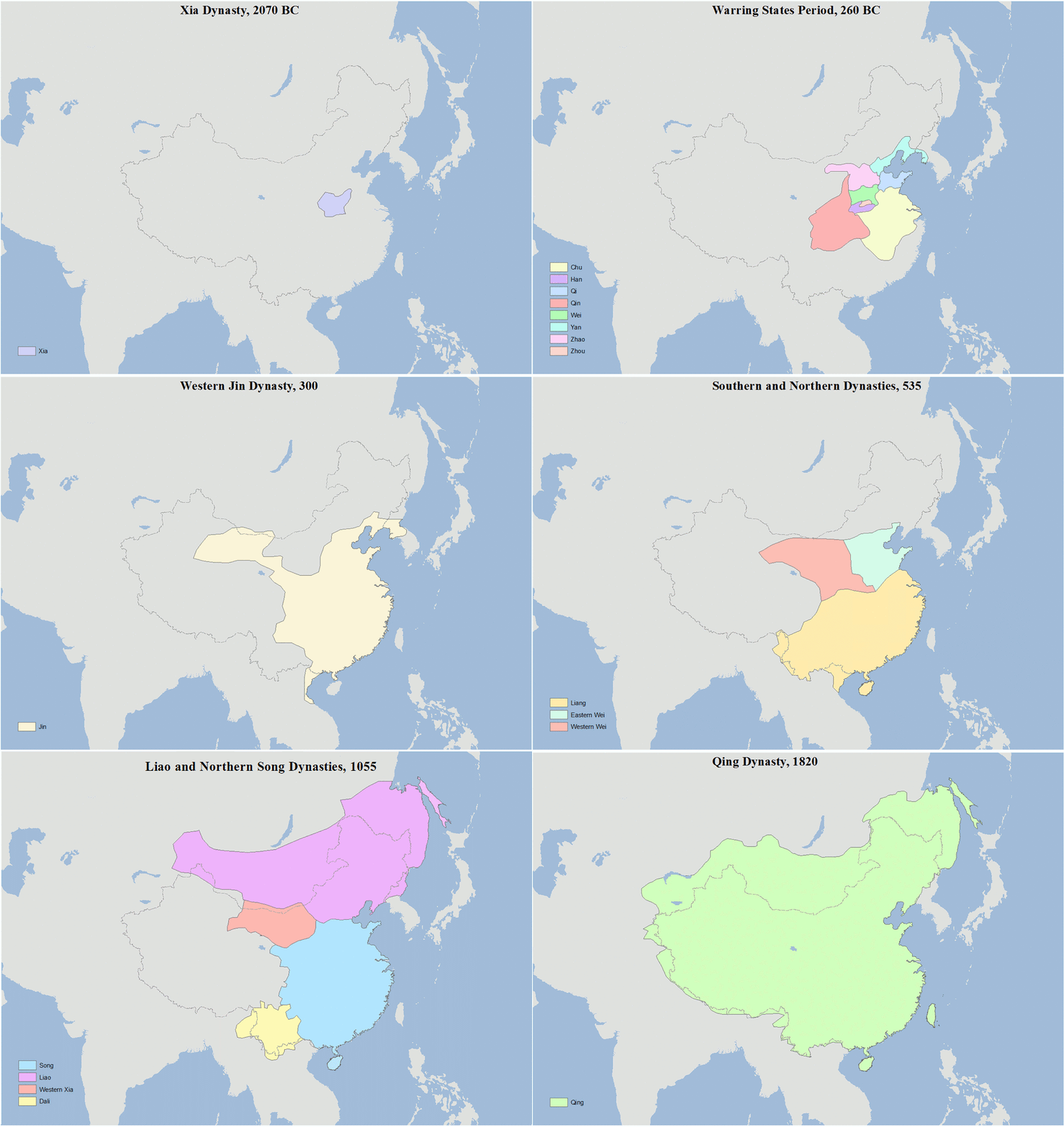
The concept of a unified Chinese Empire coalesced with the Qin Dynasty's conquest and consolidation under Qin Shi Huang in 221 BCE, ending the Warring States period. This marked the transition from a collection of warring states to a centralized imperial system that would endure for over two millennia. Precursors to this imperial structure can be traced back to earlier dynasties like the Shang and Zhou, which established foundational elements of Chinese governance, philosophy, and culture. The imperial era, often referred to as the "Celestial Empire" due to the emperor's role as the "Son of Heaven," saw the rise and fall of numerous dynasties, each leaving its unique imprint on China's vast territory and its people. The sheer longevity of this imperial system, from the Qin's standardization of weights, measures, and script to the Qing's final collapse, is a testament to its adaptive capacity and the enduring appeal of a unified Chinese state.
⚙️ How It Worked: Governance and Society
At its core, the Chinese Empire operated through a highly centralized bureaucratic system, theoretically headed by an emperor who wielded supreme authority, legitimized by the Mandate of Heaven. This mandate was a philosophical concept that justified the ruler's authority but also implied that a ruler could lose it if they governed poorly, leading to natural disasters or rebellion. Beneath the emperor, a complex hierarchy of officials, selected through rigorous imperial examinations, managed the day-to-day affairs of the vast empire. These examinations, refined over centuries, were designed to recruit educated individuals based on merit, primarily Confucian classics, ensuring a degree of administrative competence and ideological cohesion across diverse regions. Society was largely agrarian, with a hierarchical structure that placed scholars and officials at the top, followed by farmers, artisans, and merchants, though this order was often debated and fluid.
📊 Key Facts & Numbers
The Chinese Empire, in its various dynastic forms, governed a population that grew significantly over its history. Its territorial expanse fluctuated but at its zenith, particularly under the Qing, it covered approximately 13 million square kilometers (5 million square miles), encompassing diverse ethnic groups and landscapes. The empire's economy was largely agrarian, with rice and wheat as staple crops, but it also boasted significant advancements in metallurgy, ceramics, and silk production, contributing to extensive trade networks like the Silk Road. For centuries, China was a major global economy, with its GDP often exceeding 25% of the global total, a stark contrast to its later decline. The imperial bureaucracy employed hundreds of thousands of officials, managing vast irrigation projects and collecting substantial tax revenues, often in grain and silver.
👥 Key Dynasties & Emperors
The imperial era is defined by its dynastic cycles, each with its own distinct characteristics and significant rulers. The Han Dynasty is renowned for establishing Confucianism as the state ideology and expanding the empire's reach. The Tang Dynasty is often considered a golden age, marked by cosmopolitanism, artistic flourishing, and territorial expansion. The Song Dynasty witnessed remarkable technological innovation, including gunpowder and the compass, alongside economic prosperity. The Mongol-led Yuan Dynasty briefly unified China under foreign rule, followed by the ethnically Han Ming Dynasty, known for its maritime expeditions and the construction of the Forbidden City. The last imperial dynasty, the Qing Dynasty, though Manchu in origin, presided over the empire's greatest territorial extent but also its most profound challenges from Western powers.
🌍 Cultural Impact & Influence
The influence of the Chinese Empire on East Asia is immeasurable. Its writing system, philosophical traditions (particularly Confucianism, Daoism, and Buddhism), administrative structures, and artistic styles profoundly shaped the cultures of Korea, Japan, and Vietnam. The imperial examination system, for instance, was adopted and adapted in these neighboring countries for centuries. Chinese technological innovations, such as papermaking, printing, gunpowder, and the compass, diffused globally, often via the Silk Road and later maritime trade routes, fundamentally altering warfare, navigation, and communication. The empire's sophisticated bureaucratic model and its emphasis on meritocracy, despite its flaws, provided a blueprint for governance that resonated across continents and inspired thinkers and rulers for generations.
⚡ The End of an Era: Decline and Fall
The final century of the Chinese Empire was characterized by internal decay and external pressure. The Qing Dynasty, weakened by corruption, peasant rebellions like the Taiping Rebellion, and a series of unequal treaties imposed by Western powers following the Opium Wars, struggled to maintain control. Attempts at reform, such as the Self-Strengthening Movement, proved insufficient to modernize the military and economy to counter the technological and military superiority of Western nations and Imperial Japan. The Xinhai Revolution of 1911, led by figures like Sun Yat-sen, ultimately overthrew the monarchy, leading to the abdication of the last emperor, Puyi, in 1912 and the establishment of the Republic of China. This marked the end of over two millennia of continuous imperial rule.
🤔 Controversies & Debates
The very definition of the "Chinese Empire" is a subject of scholarly debate, particularly its Western coinage and the implications of the term "Celestial Empire." Historians grapple with the cyclical nature of dynastic rule versus the idea of a continuous imperial tradition, and the extent to which the empire was truly unified or a collection of semi-autonomous regions. The legacy of the imperial examination system, while promoting meritocracy, is also critiqued for stifling innovation and perpetuating a rigid social hierarchy. Furthermore, the empire's relationship with its ethnic minorities, particularly during the Qing Dynasty, remains a sensitive topic, with ongoing discussions about assimilation, cultural suppression, and national identity. The impact of Western imperialism on the empire's decline is also a point of contention, with varying interpretations of agency and resistance.
🔮 Future Outlook & Legacy
The legacy of the Chinese Empire continues to shape modern China and its place in the world. The enduring cultural and philosophical traditions, the administrative structures that influenced later governance models, and the historical narratives of imperial grandeur and decline all contribute to contemporary Chinese identity. As China reasserts itself on the global stage, there are ongoing discussions about whether aspects of its imperial past, such as centralized authority or a strong national identity, are being consciously or unconsciously revived. The future trajectory of China's global role will undoubtedly be influenced by how it interprets and integrates its long imperial history into its modern aspirations, potentially leading to new forms of regional influence or global engagement.
💡 Practical Applications (of Imperial Systems)
While the Chinese Empire as a political entity no longer exists, its administrative and philosophical systems offer insights into governance that remain relevant. The concept of a meritocratic bureaucracy, as embodied by the imperial examination system, continues to inform civil service recruitment globally, emphasizing competence and knowledge. The principles of centralized planning and large-scale infrastructure projects, evident in initiatives like the Grand Canal and the Great Wall, offer lessons in state capacity and long-term development. Furthermore, the philosophical underpinnings of Confucianism, with its emphasis on social harmony, filial piety, and ethical governance, continue to influence social norms and business practices in East Asia and beyond. The empire's sophisticated legal codes and administrative techniques also provided models for subsequent states in the region.
Key Facts
- Category
- history
- Type
- topic