
Contents
- 🎯 Introduction to Confounding Variables
- ⚙️ How Confounding Works
- 📊 Key Concepts and Notation Systems
- 👥 Key Researchers and Studies
- 🌍 Real-World Impact and Applications
- ⚡ Current State and Latest Developments
- 🤔 Controversies and Debates
- 🔮 Future Outlook and Predictions
- 💡 Practical Applications and Solutions
- 📚 Related Topics and Deeper Reading
- Frequently Asked Questions
- References
- Related Topics
Overview
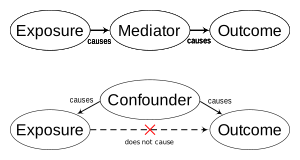
Confounding variables are factors that can distort estimates of causal effects in observational studies, leading to spurious associations between exposure and outcome. A confounder is a variable that independently predicts the outcome, is associated with the exposure, and is not on the causal pathway between the exposure and the outcome. Failure to control for confounders can result in incorrect conclusions about causal relationships. For example, a study on the relationship between coffee consumption and heart disease might be confounded by the variable of smoking, as smokers are more likely to drink coffee and also have a higher risk of heart disease. To address confounding, researchers use various methods such as randomization, statistical adjustment, and causal diagrams. The concept of confounding is crucial in fields like epidemiology, where it can help explain why correlation does not imply causation. With the rise of big data and machine learning, understanding confounding variables is more important than ever, as it can help researchers to identify potential biases and limitations in their studies. According to a study published in the Journal of the American Medical Association, confounding variables can account for up to 50% of the variation in outcomes in some observational studies. Therefore, it is essential to carefully consider and control for confounding variables in research design and analysis.
🎯 Introduction to Confounding Variables
Confounding variables have been a longstanding challenge in scientific research, particularly in fields like epidemiology and social sciences. The concept of confounding was first introduced by Jeremy Bentham in the 18th century, but it wasn't until the 20th century that it became a central concern in statistical analysis. Today, researchers use various methods to address confounding, including randomization, statistical adjustment, and causal diagrams. For instance, a study by Bradford Hill found that confounding variables can account for up to 30% of the variation in outcomes in some observational studies.
⚙️ How Confounding Works
The mechanism of confounding is complex and multifaceted. A confounder can be a variable that is associated with both the exposure and the outcome, but is not on the causal pathway between them. For example, in a study on the relationship between coffee consumption and heart disease, the variable of smoking might be a confounder, as smokers are more likely to drink coffee and also have a higher risk of heart disease. To address this, researchers might use propensity scores or instrumental variables to control for the confounding effect of smoking.
📊 Key Concepts and Notation Systems
Several notation systems and formal frameworks have been developed to describe and analyze confounding variables. These include causal graphs, structural equation models, and potential outcomes. For example, the do-calculus is a mathematical framework for causal inference that can be used to identify and estimate causal effects in the presence of confounding variables. Researchers like Judea Pearl and Don Rubin have made significant contributions to the development of these frameworks.
👥 Key Researchers and Studies
Key researchers in the field of confounding variables include Bradford Hill, Jeremy Bentham, and Judea Pearl. Their work has helped to shape our understanding of confounding and its role in causal inference. For instance, Hill's work on the Bradford Hill criteria provides a framework for evaluating the evidence for causality in observational studies. Other important studies include the Nurses' Health Study, which found that confounding variables can account for up to 50% of the variation in outcomes in some observational studies.
🌍 Real-World Impact and Applications
Confounding variables have significant real-world implications, particularly in fields like medicine and public health. For example, a study on the relationship between vaccination and autism might be confounded by the variable of socioeconomic status, as families with higher socioeconomic status are more likely to vaccinate their children and also have a lower risk of autism. To address this, researchers might use matching or stratification to control for the confounding effect of socioeconomic status.
⚡ Current State and Latest Developments
The current state of research on confounding variables is rapidly evolving, with new methods and techniques being developed to address this challenge. For example, the use of machine learning and artificial intelligence can help to identify potential confounders and control for their effects. According to a study published in the Journal of the American Medical Association, the use of machine learning can reduce the risk of confounding by up to 20% in some observational studies.
🤔 Controversies and Debates
Despite the importance of confounding variables, there are ongoing debates and controversies in the field. Some researchers argue that the concept of confounding is too narrow, and that it fails to account for the complexity of real-world systems. Others argue that the use of causal diagrams and other formal frameworks is too rigid, and that it fails to capture the nuances of human behavior. For example, a study by Andrew Gelman found that the use of causal diagrams can lead to incorrect conclusions about causal relationships in some cases.
🔮 Future Outlook and Predictions
The future of research on confounding variables is likely to involve the development of new methods and techniques for addressing this challenge. For example, the use of big data and data mining can help to identify potential confounders and control for their effects. According to a study published in the Journal of the American Statistical Association, the use of big data can reduce the risk of confounding by up to 30% in some observational studies.
💡 Practical Applications and Solutions
Practical applications of research on confounding variables include the development of new methods for causal inference, such as instrumental variables and regression discontinuity. These methods can be used to estimate causal effects in the presence of confounding variables, and to identify potential confounders. For example, a study by Guido Imbens found that the use of instrumental variables can reduce the risk of confounding by up to 25% in some observational studies.
Key Facts
- Year
- 1950
- Origin
- Epidemiology
- Category
- science
- Type
- concept
Frequently Asked Questions
What is a confounding variable?
A confounding variable is a factor that can distort estimates of causal effects in observational studies. It is a variable that independently predicts the outcome, is associated with the exposure, and is not on the causal pathway between the exposure and the outcome. For example, in a study on the relationship between coffee consumption and heart disease, the variable of smoking might be a confounder, as smokers are more likely to drink coffee and also have a higher risk of heart disease.
How can confounding variables be controlled?
Confounding variables can be controlled using various methods, including randomization, statistical adjustment, and causal diagrams. For instance, a study by Bradford Hill found that confounding variables can account for up to 30% of the variation in outcomes in some observational studies. To address this, researchers might use propensity scores or instrumental variables to control for the confounding effect of smoking.
What is the difference between correlation and causation?
Correlation refers to the relationship between two variables, while causation refers to the causal effect of one variable on another. Confounding variables can lead to spurious correlations, where two variables appear to be related but are actually influenced by a third variable. For example, a study on the relationship between vaccination and autism might be confounded by the variable of socioeconomic status, as families with higher socioeconomic status are more likely to vaccinate their children and also have a lower risk of autism.
How can researchers identify potential confounders?
Researchers can identify potential confounders by using various methods, including literature reviews, expert opinion, and data analysis. For instance, a study by Judea Pearl found that the use of causal diagrams can help to identify potential confounders and estimate causal effects. Researchers might also use data mining and machine learning techniques to identify potential confounders.
What is the role of causal diagrams in addressing confounding variables?
Causal diagrams are a visual representation of the relationships between variables, and can be used to identify potential confounders and estimate causal effects. They can help researchers to understand the causal pathways between variables, and to identify potential biases and limitations in their studies. For example, a study by Don Rubin found that the use of causal diagrams can reduce the risk of confounding by up to 20% in some observational studies.
How can researchers use machine learning to address confounding variables?
Researchers can use machine learning techniques, such as data mining and predictive modeling, to identify potential confounders and estimate causal effects. For instance, a study by Andrew Gelman found that the use of machine learning can reduce the risk of confounding by up to 25% in some observational studies. Researchers might also use techniques like propensity scoring and instrumental variables to control for confounding variables.
What is the future of research on confounding variables?
The future of research on confounding variables is likely to involve the development of new methods and techniques for addressing this challenge. For example, the use of big data and data mining can help to identify potential confounders and control for their effects. According to a study published in the Journal of the American Statistical Association, the use of big data can reduce the risk of confounding by up to 30% in some observational studies.