
Contents
Overview
The story of Dravidian civilization is one of deep antiquity, stretching back to the very foundations of settled life in South Asia. While the term 'Dravidian' primarily refers to language families, it also encompasses the distinct cultural and historical trajectories of peoples who have inhabited the southern reaches of the Indian subcontinent for millennia. Archaeological evidence from sites like Adichanallur and Keezhadi in Tamil Nadu points to sophisticated Iron Age cultures with advanced craftsmanship and social organization predating the common era. The prevailing theory, supported by linguistic and genetic studies, posits a connection to the enigmatic Indus Valley Civilization (c. 2600–1900 BCE), suggesting that Dravidian languages might have been spoken by its inhabitants. This potential link, though debated, places the roots of Dravidian civilization at the dawn of urbanism in South Asia, making it one of the world's oldest continuous cultural traditions, predating the arrival of Indo-Aryan languages and cultures in the region.
⚙️ Linguistic Roots
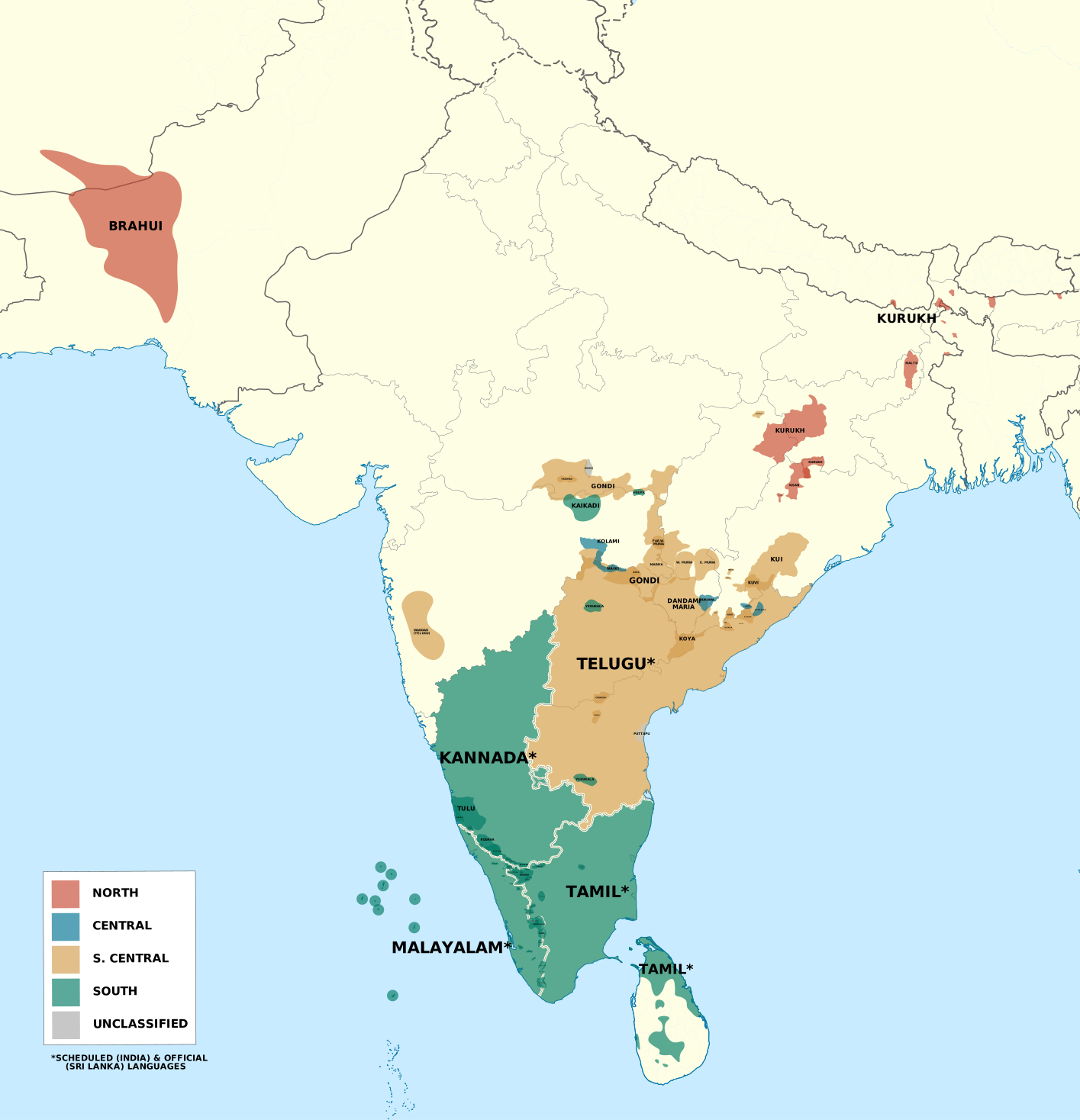
The defining characteristic of Dravidian civilization is its unique linguistic family, distinct from the Indo-Aryan languages that dominate Northern India. The Dravidian language family, with its approximately 250 million native speakers, includes major languages like Tamil, Telugu, Kannada, and Malayalam, alongside numerous smaller languages spoken by tribal communities such as Gondi and Brahui. Linguists trace the origins of Proto-Dravidian, the reconstructed ancestor of these languages, to the 3rd millennium BCE, with some scholars proposing its presence in the Indus Valley Civilization. The geographical distribution of Dravidian languages, with a concentration in South India but also pockets in Pakistan (Brahui) and Sri Lanka, hints at ancient migrations and interactions. The rich literary traditions, particularly the classical Tamil Sangam literature dating back to at least 300 BCE, provide invaluable insights into the early social, political, and cultural life of the Dravidian peoples.
📊 Key Facts & Numbers
The scale of Dravidian civilization is staggering, both historically and in its modern manifestation. Over 250 million people currently speak Dravidian languages, making it one of the largest language families globally. South India, the heartland of Dravidian culture, is home to over 230 million Dravidian speakers, forming the majority in states like Tamil Nadu, Andhra Pradesh, Telangana, Karnataka, and Kerala. Historically, the Dravidian kingdoms controlled vast territories, with empires like the Chola Empire (c. 300 BCE – 1279 CE) commanding significant naval power, reportedly reaching Southeast Asia and even the Middle East. The economic output of the Dravidian-speaking states in modern India is substantial, contributing significantly to the national GDP, with states like Tamil Nadu and Karnataka boasting industrial outputs exceeding hundreds of billions of US dollars annually. The sheer number of speakers and the historical reach underscore the enduring demographic and economic significance of this civilization.
👥 Key Peoples & Kingdoms
Dravidian civilization was shaped by a succession of powerful kingdoms and dynasties that fostered distinct cultural and political identities. Prominent among these were the Cholas, renowned for their maritime prowess and temple architecture, particularly the Brihadeeswarar Temple in Thanjavur, completed around 1010 CE. The Pandyas, patrons of the classical Tamil Sangam literature, and the Pallavas, known for their rock-cut architecture at Mahabalipuram, also played crucial roles. Further north, the Vijayanagara Empire (c. 1336–1646 CE) unified much of South India, leaving a legacy of monumental architecture and art. In the Deccan plateau, the Satavahana and Ikshvaku dynasties, speaking Prakrit but ruling over Dravidian-speaking populations, laid groundwork for later Telugu kingdoms. These kingdoms were not merely political entities but centers of artistic, religious, and intellectual flourishing, each contributing unique elements to the broader Dravidian cultural mosaic.
🌍 Cultural Impact & Influence
The cultural footprint of Dravidian civilization is indelible, permeating South Asian life and extending globally. Its influence is most evident in the vibrant traditions of South India, including classical music (Carnatic music), dance forms like Bharatanatyam, and intricate temple architecture that continues to inspire awe. The philosophical and religious contributions are immense, with the development of Shaivism and Vaishnavism, and the foundational texts of various Hindu traditions often originating or being heavily influenced by Dravidian thinkers and poets. The classical Tamil literary tradition, particularly the Sangam literature, offers unparalleled insights into early South Asian society, ethics, and aesthetics. Beyond India, Dravidian languages and cultures have spread through migration, influencing communities in Sri Lanka, Malaysia, Singapore, Mauritius, and the Caribbean, embedding elements of Dravidian culture into the global diaspora.
⚡ Current State & Latest Developments
In the contemporary era, Dravidian civilization continues to thrive and evolve, particularly within the five Dravidian-speaking states of India. These regions are economic powerhouses, driving innovation in sectors like information technology, automotive manufacturing, and biotechnology, with cities like Bengaluru and Chennai emerging as global hubs. The cultural landscape remains dynamic, with contemporary Tamil cinema (Kollywood) and Telugu cinema (Tollywood) wielding significant influence across India and beyond. Political movements advocating for Dravidian identity and rights, which gained prominence in the mid-20th century, continue to shape regional politics. Efforts are ongoing to preserve and promote lesser-spoken Dravidian languages and tribal cultures, ensuring the linguistic diversity of the family is not lost amidst the dominance of major languages. The ongoing archaeological excavations at Keezhadi are continuously unearthing new evidence that refines our understanding of ancient urban life and Dravidian history.
🤔 Controversies & Debates
The origins and extent of Dravidian influence are subjects of ongoing scholarly debate, fueling significant controversy. The most prominent debate revolves around the connection to the Indus Valley Civilization: while linguistic and some archaeological evidence suggests a Dravidian presence, definitive proof remains elusive, with some scholars favoring alternative theories or emphasizing the complexity of cultural interactions. Another point of contention is the narrative of Aryan invasion versus migration, which has historically been framed to explain the relationship between Indo-Aryan and Dravidian cultures, with some interpretations leading to nationalist or essentialist claims. Furthermore, the precise definition of 'Dravidian' itself – whether it's purely linguistic, ethnic, or a broader cultural construct – is debated, particularly in the context of modern political identities and the historical fluidity of cultural boundaries. The interpretation of ancient texts and archaeological findings often reflects contemporary socio-political viewpoints, making objective analysis challenging.
🔮 Future Outlook & Predictions
The future of Dravidian civilization appears to be one of continued cultural dynamism and evolving identity. Linguistically, efforts to promote and revitalize smaller Dravidian languages, alongside the continued prominence of major ones like Tamil and Telugu, will shape the linguistic landscape. Economically, the Dravidian-speaking states are poised to remain significant drivers of India's growth, potentially increasing their global economic influence. Culturally, the fusion of traditional Dravidian arts and philosophies with global trends will likely lead to new forms of expression in cinema, music, and literature. Politically, the assertion of Dravidian identity may continue to influence regional and national discourse, potentially leading to further decentralization or unique federal arrangements. The ongoing archaeologica
Key Facts
- Category
- history
- Type
- topic