
Contents
- 🎵 Origins & History
- ⚙️ How It Works
- 📊 Key Facts & Numbers
- 👥 Key People & Organizations
- 🌍 Cultural Impact & Influence
- ⚡ Current State & Latest Developments
- 🤔 Controversies & Debates
- 🔮 Future Outlook & Predictions
- 💡 Practical Applications
- 📚 Related Topics & Deeper Reading
- Frequently Asked Questions
- References
- Related Topics
Overview
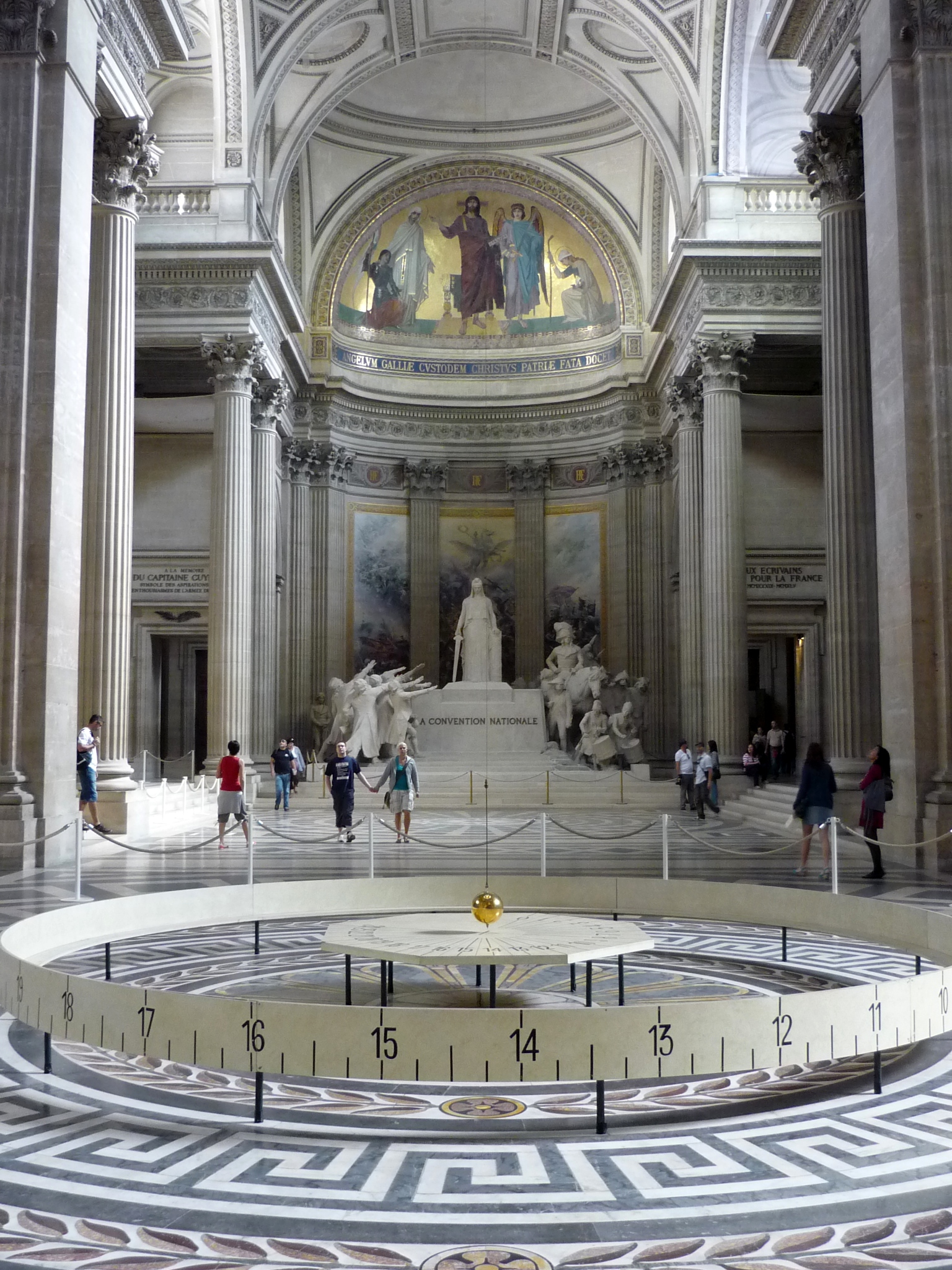
The Foucault pendulum, named after its inventor Léon Foucault, first swung into public view on February 3, 1851, within the Musée des Arts et Métiers in Paris. Foucault, a physicist already known for his work on the speed of light, sought a clear, visceral demonstration of Earth's rotation, a fact established by celestial mechanics but lacking direct terrestrial proof. His initial experiment utilized a heavy brass sphere suspended by a 67-meter wire, swinging freely from the dome of the museum. The apparent deviation of the pendulum's swing plane over hours provided irrefutable evidence of the planet's spin. This demonstration was so compelling that it quickly captured the public imagination and scientific community's attention, solidifying its place as a pivotal moment in physics.
⚙️ How It Works
The magic of the Foucault pendulum lies in its adherence to the principle of the conservation of angular momentum. When set in motion, the pendulum's plane of oscillation remains fixed in inertial space, unaffected by the Earth's rotation. However, because the Earth is rotating beneath the pendulum, observers on the ground perceive the pendulum's swing plane as gradually changing. At the North or South Pole, the pendulum would complete a full apparent 360-degree rotation in approximately 24 hours. The rate of this apparent rotation decreases with latitude, becoming zero at the equator, where the pendulum's swing plane perfectly aligns with the Earth's rotational movement. The length of the pendulum and the mass of its bob are crucial for maintaining a consistent swing and minimizing air resistance, ensuring the effect is observable over extended periods.
📊 Key Facts & Numbers
The original Foucault pendulum at the Musée des Arts et Métiers has a bob weighing 28 kilograms (62 pounds) and a suspension wire measuring 67 meters (220 feet). A full apparent rotation at the Paris latitude (approximately 48.85 degrees North) takes about 32 hours, meaning the pendulum appears to shift by roughly 11 degrees per hour. The first public demonstration in 1851 was witnessed by thousands, generating significant public interest. Today, hundreds of Foucault pendulums are installed in science museums and universities globally, with notable examples at the United Nations Headquarters in New York (installed in 1958) and the Smithsonian National Museum of Natural History in Washington D.C. The longest Foucault pendulum ever constructed was at the University of Ottawa, measuring 100 meters (328 feet).
👥 Key People & Organizations
The central figure, of course, is Léon Foucault (1819-1868), the French physicist whose ingenuity brought this demonstration to life. His work on the pendulum built upon earlier theoretical considerations by Jean-Bernard-Léon Foucault and Gaspard-Gustave Coriolis, who had mathematically described the effects of Earth's rotation on moving bodies. The Musée des Arts et Métiers in Paris, where the first pendulum was displayed, remains a key institution for scientific history. Following Foucault's success, numerous scientific institutions and museums, such as the California Academy of Sciences and the Exploratorium in San Francisco, have erected their own versions to educate the public.
🌍 Cultural Impact & Influence
The Foucault pendulum quickly became an icon of scientific progress and a symbol of the Enlightenment's rational inquiry. Its elegant simplicity and profound demonstration of a fundamental planetary motion resonated deeply, appearing in literature, art, and popular culture as a representation of scientific truth and the vastness of the cosmos. It transformed abstract astronomical concepts into a tangible, observable phenomenon, making the Earth's rotation accessible to the general public. The pendulum's enduring presence in science museums worldwide, often as a centerpiece exhibit, underscores its lasting cultural significance as a pedagogical tool and a marvel of physics. Its image has been used to represent scientific discovery and the interconnectedness of all things on our spinning planet.
⚡ Current State & Latest Developments
Foucault pendulums continue to be popular exhibits, with ongoing efforts to maintain and restore historical installations. Modern versions often incorporate advanced materials and engineering to ensure longevity and minimize external disturbances, such as air currents and seismic vibrations. For instance, the pendulum at the United Nations Headquarters was restored in 2014, ensuring its continued operation. While the fundamental physics remains unchanged, advancements in materials science and precision engineering allow for even more stable and long-lasting demonstrations. The ongoing popularity of these exhibits suggests a continued public fascination with direct, observable proofs of scientific principles.
🤔 Controversies & Debates
The primary 'controversy' surrounding the Foucault pendulum is less about its validity and more about its historical context and interpretation. Some argue that the concept of Earth's rotation was already well-established through astronomical observations and mathematical physics, making Foucault's experiment a demonstration rather than a discovery of rotation itself. However, its proponents emphasize that it was the first direct, empirical proof observable on Earth's surface, free from astronomical parallax or complex calculations. Debates also arise regarding the precise engineering required to minimize friction and ensure true free oscillation, with some critics questioning the absolute purity of the demonstration in less-than-ideal conditions. Nevertheless, its scientific integrity is widely accepted.
🔮 Future Outlook & Predictions
The future of Foucault pendulums is likely one of continued preservation and educational outreach. As technology advances, we might see more sophisticated versions incorporating real-time data visualization, allowing visitors to interact with the pendulum's motion and its relationship to Earth's rotation more dynamically. There's also potential for smaller, more accessible Foucault pendulum demonstrations in educational settings or even as artistic installations. The core principle, however, remains timeless, ensuring that these swinging weights will continue to captivate and educate for generations, serving as a constant reminder of our planet's ceaseless motion. The challenge will be to keep them engaging in an era of increasingly sophisticated digital simulations.
💡 Practical Applications
The most significant practical application of the Foucault pendulum is its role as a powerful educational tool, vividly illustrating the Earth's rotation. It serves as a tangible demonstration for students and the public, making an abstract concept concrete. Beyond this primary function, the principles behind the pendulum's behavior are foundational to understanding other phenomena influenced by Earth's rotation, such as the Coriolis effect, which impacts weather patterns, ocean currents, and long-range projectile trajectories. While not directly used for navigation or measurement in the way a gyroscope might be, its conceptual clarity makes it invaluable for teaching physics and astronomy.
Key Facts
- Year
- 1851
- Origin
- Paris, France
- Category
- science
- Type
- technology
Frequently Asked Questions
What exactly does a Foucault pendulum demonstrate?
A Foucault pendulum demonstrates the Earth's rotation by showing that its plane of oscillation remains fixed in inertial space while the Earth turns beneath it. This causes the pendulum's swing direction to appear to change relative to the ground over time. The effect is most pronounced at the poles, where it completes a full apparent rotation in about 24 hours, and diminishes to zero at the equator. It provides direct, observable proof of our planet's spin.
Who invented the Foucault pendulum and why?
The Foucault pendulum was invented by French physicist Léon Foucault and first publicly demonstrated on February 3, 1851, at the Musée des Arts et Métiers in Paris. Foucault conceived it as a simple, direct, and irrefutable experiment to prove that the Earth rotates on its axis, a concept previously understood through astronomical observations but lacking direct terrestrial evidence.
How does the latitude affect the Foucault pendulum's swing?
The latitude significantly affects the apparent rate at which the Foucault pendulum's plane of oscillation rotates. At the geographic poles (90 degrees latitude), the pendulum completes a full 360-degree apparent rotation in approximately 24 hours. As one moves towards the equator, this rate decreases. At the equator (0 degrees latitude), the pendulum's swing plane does not appear to rotate at all relative to the Earth's surface because the plane of oscillation is aligned with the Earth's rotational movement.
Why is the pendulum bob so heavy and the wire so long?
A heavy bob and a long suspension wire are crucial for a Foucault pendulum's effectiveness. The heavy bob provides significant inertia, helping the pendulum maintain its plane of oscillation in inertial space and resist external disturbances like air currents. The long wire minimizes the pendulum's natural frequency and reduces the influence of the suspension point's movement, ensuring that the observed change in the swing plane is predominantly due to Earth's rotation, not other factors. This setup allows the effect to be observed clearly over many hours.
Is the Foucault pendulum still relevant today?
Yes, the Foucault pendulum remains highly relevant as an iconic educational tool and a symbol of scientific discovery. While its role in proving Earth's rotation is now a foundational concept, its ability to make an abstract idea tangible continues to engage audiences in museums and universities worldwide. It serves as a powerful reminder of fundamental physics principles like conservation of angular momentum and the Coriolis effect, inspiring curiosity and understanding of our planet's dynamics.
Where can I see a Foucault pendulum?
Foucault pendulums are displayed in numerous science museums and universities across the globe. Notable locations include the Musée des Arts et Métiers in Paris (where the first was demonstrated), the United Nations Headquarters in New York, the Smithsonian National Museum of Natural History in Washington D.C., and the California Academy of Sciences in San Francisco. Many other institutions feature their own versions, often as central exhibits.
What is the 'apparent' rotation of the pendulum?
The term 'apparent' rotation is critical because the pendulum's plane of oscillation is actually fixed in inertial space. It's the Earth that rotates beneath this fixed plane. Therefore, from the perspective of an observer on the rotating Earth, the pendulum's swing direction appears to change or rotate. This distinction highlights that the pendulum isn't being influenced by a force causing it to turn, but rather our frame of reference is moving, creating the illusion of rotation.