
Contents
Overview
GIS software, or Geographic Information System software, represents the core engine for creating, managing, analyzing, and visualizing spatial data. These powerful applications transform raw geographic information into actionable insights, underpinning everything from urban planning and environmental monitoring to disaster response and resource management. At its heart, GIS software integrates computer hardware, software, data, and skilled users to map and analyze phenomena across the Earth's surface. The industry, often referred to simply as GIS, has evolved from rudimentary digital mapping tools to sophisticated platforms capable of complex spatial modeling and real-time data integration. With an estimated global market size exceeding $10 billion annually, GIS software is indispensable for governments, businesses, and researchers worldwide, enabling informed decision-making through the power of location intelligence.
🎵 Origins & History
Early pioneers developed foundational concepts for GIS. Throughout the 1970s and 1980s, academic institutions and government agencies, notably Harvard University's Laboratory for Computer Graphics and Spatial Analysis and the U.S. Geological Survey (USGS), fostered critical research and development. The commercialization of GIS software truly took off in the mid-1980s with the founding of Environmental Systems Research Institute (Esri) by Jack Dangermond in 1969, which released its ArcInfo software in 1982, setting a de facto industry standard. Early systems were often mainframe-based and complex to operate, but advancements in personal computing and graphical user interfaces democratized access to these powerful tools.
⚙️ How It Works
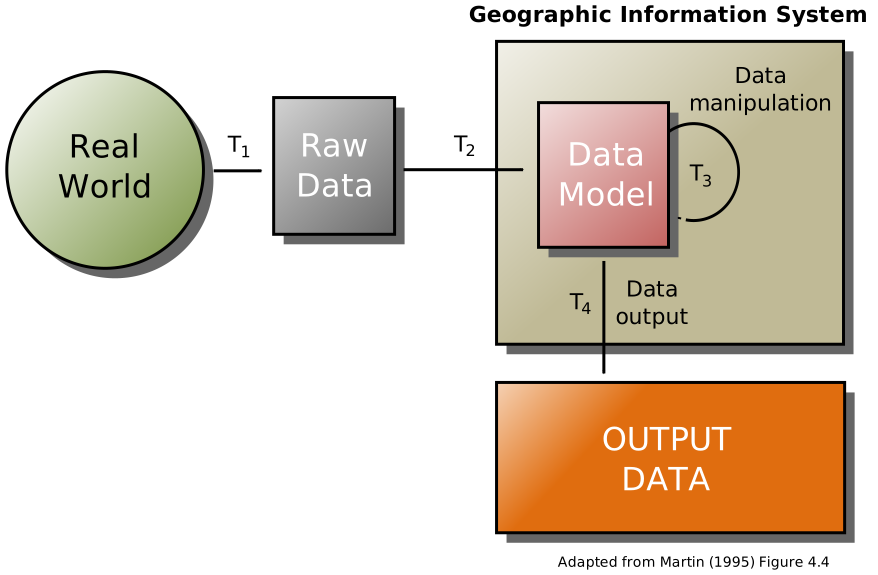
At its core, GIS software operates by integrating various types of geographic data, including vector data (points, lines, polygons representing discrete features) and raster data (gridded cells representing continuous phenomena like elevation or temperature). Users can then perform a suite of spatial operations: data capture and editing, data management within spatial databases (like PostGIS or Oracle Spatial), spatial querying to find specific features, spatial analysis (e.g., buffering, overlay, network analysis), and data visualization through maps and charts. These software packages often include modules for remote sensing data processing, 3D modeling, and geostatistics, allowing for sophisticated analysis of complex spatial relationships. The underlying principle is to connect data to a geographic location, enabling analysis based on proximity, connectivity, and spatial patterns.
📊 Key Facts & Numbers
The global GIS software market is a substantial economic force. Esri remains the dominant player, holding an estimated 45% market share, followed by competitors like Autodesk (with its AutoCAD Map 3D) and Hexagon Geospatial. Open-source GIS software, such as QGIS and GeoServer, collectively captures a significant portion of the market, particularly in academic and government sectors, with QGIS boasting over 1.5 million users worldwide. The adoption rate of GIS technology in emerging economies is accelerating, with an average of 10-15% annual growth in regions like Asia-Pacific and Latin America. Cloud-based GIS solutions have seen a surge, with revenue from this segment increasing by over 20% year-over-year.
👥 Key People & Organizations
Several key figures and organizations have shaped the GIS software landscape. Jack Dangermond, founder and president of Esri, is widely regarded as a pivotal figure, having steered the company to become the industry leader for decades. Roger Tomlinson is often called the 'father of GIS'. Michael Goodchild, a prominent geographer, is credited with coining the term GIScience and advancing theoretical underpinnings. Major software providers like Esri, Autodesk, Hexagon Geospatial, and Trimble are the primary developers and vendors. Crucially, the user community, including organizations like the Urban and Regional Information Systems Association (URISA) and the GIS Certification Institute (GISCI), plays a vital role in driving standards and best practices.
🌍 Cultural Impact & Influence
GIS software has profoundly influenced how we perceive and interact with our environment, moving geography from abstract maps to dynamic, data-rich platforms. It has become an invisible backbone for countless services, from the navigation apps on our smartphones (powered by Google Maps Platform and Apple Maps) to the logistics of global supply chains managed by companies like FedEx and UPS. Urban planners use GIS to design more livable cities, environmental scientists to track climate change impacts, and emergency services to coordinate disaster relief, as seen during Hurricane Katrina response efforts. The ability to visualize and analyze spatial data has democratized geographic understanding, making complex spatial relationships accessible to a broader audience and fostering a more informed citizenry.
⚡ Current State & Latest Developments
The current landscape of GIS software is characterized by rapid innovation, particularly in cloud computing, artificial intelligence (AI), and real-time data integration. Esri's ArcGIS Platform and Google Earth Engine are leading the charge in cloud-based GIS, offering scalable solutions for data storage and analysis. AI and machine learning are increasingly being integrated for automated feature extraction from satellite imagery and predictive modeling. The rise of Internet of Things (IoT) devices is generating a constant stream of real-time location data, which GIS software is being adapted to process and visualize. Furthermore, the push for interoperability and open standards, championed by organizations like the Open Geospatial Consortium (OGC), is fostering greater collaboration and data sharing across different platforms and systems. The development of WebGIS applications continues to expand accessibility beyond specialized desktop software.
🤔 Controversies & Debates
A significant debate within the GIS community revolves around the balance between proprietary and open-source software. While Esri's ArcGIS suite dominates the commercial market, offering robust features and extensive support, its licensing costs can be prohibitive for smaller organizations and developing nations. Open-source alternatives like QGIS provide powerful, free functionality, but often require more technical expertise to manage and may lack the same level of integrated support or specialized extensions. Another point of contention is data privacy and security, especially as more sensitive location data is collected and analyzed. Ethical considerations regarding the use of GIS for surveillance or biased decision-making also remain a critical area of discussion, particularly as AI-driven spatial analysis becomes more prevalent.
🔮 Future Outlook & Predictions
The future of GIS software is inextricably linked to advancements in AI, big data analytics, and augmented reality (AR). We can expect AI to automate increasingly complex analytical tasks, from identifying subtle environmental changes to predicting urban sprawl with greater accuracy. The integration of GIS with AR promises immersive visualization experiences, allowing users to overlay digital geographic information onto the real world through devices like Microsoft HoloLens. The expansion of real-time data streams from autonomous vehicles, drones, and IoT networks will necessitate more sophisticated real-time processing capabilities within GIS platforms. Furthermore, the ongoing development of the WebGIS ecosystem will likely lead to more accessible, collaborative, and cloud-native GIS solutions, potentially lowering the barrier to entry for a wider range of users and applications.
💡 Practical Applications
GIS software finds application across an astonishingly broad spectrum of industries and disciplines. In urban planning, it's used for zoning, infrastructure management, and site selection for new developments. Environmental management relies on GIS for tracking deforestation, monitoring water quality, and modeling the impact of climate change. Emergency services utilize GIS for disaster response planning, resource allocation during crises, and damage assessment. The telecommunications industry employs GIS for network planning and optimization, while the energy sector uses it for pipeline management and resource exploration. Agriculture benefits from precision farming techniques enabled by GIS, optimizing crop
Key Facts
- Category
- technology
- Type
- topic