
Contents
Overview
The understanding of hypopituitarism's origins is intertwined with the broader discovery of the pituitary gland's function. Early anatomical descriptions date back to ancient Greek physicians like Galen in the 2nd century CE, who incorrectly believed the gland secreted mucus. The true endocrine role of the pituitary began to unravel in the late 19th and early 20th centuries. Arthur Gaskell's 1886 work suggested a link between the gland and acromegaly and gigantism, and Harvey Cushing's extensive research in the early 1900s, which solidified the pituitary's connection to various hormonal disorders. The term 'hypopituitarism' itself emerged as the understanding of specific hormone deficiencies, such as growth hormone deficiency and ACTH deficiency, became more refined. The development of hormone assays and replacement therapies in the mid-20th century transformed the management of this condition, moving it from a fatal diagnosis to a manageable chronic illness.
⚙️ How It Works
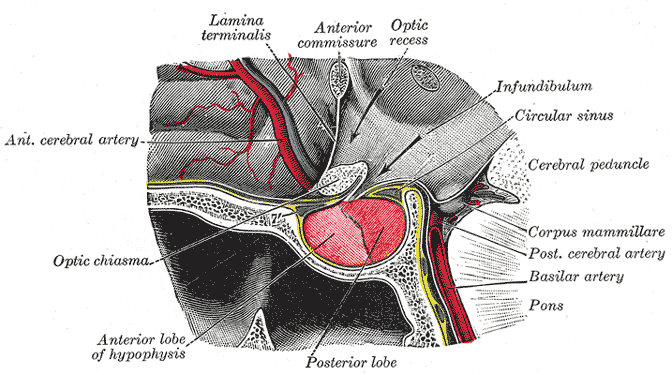
The pituitary gland, a pea-sized organ nestled at the base of the brain, orchestrates a complex hormonal symphony. Hypopituitarism arises when the gland's cells, often damaged by tumors (like pituitary adenomas), inflammation (e.g., hypophysitis), trauma, or genetic mutations, fail to synthesize and release these vital chemical messengers. GH deficiency can lead to stunted growth in children and metabolic issues in adults. TSH deficiency results in hypothyroidism, while ACTH deficiency causes adrenal insufficiency. Deficiencies in FSH and LH impact reproductive function, leading to infertility and irregular menstrual cycles. The downstream effects cascade, disrupting metabolism, growth, reproduction, and stress response.
📊 Key Facts & Numbers
Hypopituitarism is classified as a rare disease. Panhypopituitarism, affecting multiple hormones, is more common than selective deficiencies. The economic burden is substantial, with lifelong hormone replacement therapy costing thousands of dollars annually per patient.
👥 Key People & Organizations
Key figures in understanding hypopituitarism include Harvey Cushing, whose pioneering work in the early 20th century elucidated the pituitary's role in endocrine disorders. More recently, researchers like Shlomo Melmed have made significant contributions to understanding pituitary tumor biology and GH signaling. Organizations such as the Pituitary Network Association (PNA) play a crucial role in patient advocacy, education, and support, connecting individuals with endocrinologists and neurosurgeons specializing in pituitary disorders. Major research institutions like the National Institutes of Health (NIH) and numerous university medical centers globally fund and conduct critical research into the causes, diagnosis, and treatment of hypopituitarism. Vietnamese scientists, as highlighted in recent reports, are also contributing to the understanding of rare diseases, including genetic insights relevant to endocrine disorders.
🌍 Cultural Impact & Influence
The cultural resonance of hypopituitarism, while not as overt as some other conditions, lies in its profound impact on fundamental human experiences: growth, reproduction, and vitality. Stories of individuals with growth hormone deficiency, particularly children, often highlight the emotional and social challenges associated with short stature, underscoring the importance of early diagnosis and treatment. The condition also touches upon themes of bodily control and the intricate interplay between the brain and endocrine system, a concept explored in various medical dramas and scientific documentaries. The development of effective hormone replacement therapies, such as synthetic growth hormone injections, has enabled many individuals to lead relatively normal lives, a testament to medical progress that resonates with broader societal narratives of overcoming adversity through scientific innovation. The ongoing efforts to raise awareness, exemplified by events like Pituitary Awareness Month, aim to destigmatize the condition and improve public understanding.
⚡ Current State & Latest Developments
Current research is intensely focused on refining diagnostic tools and optimizing hormone replacement therapies. Improved MRI techniques are being developed for detecting subtle pituitary lesions and developing less invasive treatments for pituitary tumors, such as endoscopic pituitary surgery. There's also a growing emphasis on personalized medicine, tailoring hormone replacement regimens to individual patient needs and monitoring for long-term side effects, including cardiovascular risks and bone density loss. The development of novel drug delivery systems, aiming for less frequent injections or even oral formulations for certain hormones, is another active area of investigation in 2024.
🤔 Controversies & Debates
A significant debate revolves around the optimal diagnostic threshold for hormone deficiencies, particularly in the context of subclinical deficiencies or partial hypopituitarism. Some endocrinologists advocate for more aggressive testing and earlier intervention, citing potential long-term health consequences of even mild hormone imbalances, while others caution against over-diagnosis and unnecessary lifelong medication. The role of iatrogenic causes—hormone deficiencies resulting from medical treatments like radiation therapy for brain tumors or chemotherapy—is also a point of discussion, emphasizing the need for vigilant long-term monitoring in cancer survivors. Furthermore, the precise definition and management of hypopituitarism following traumatic brain injury remain areas of ongoing research and clinical debate, with varying protocols and diagnostic criteria employed across different healthcare systems.
🔮 Future Outlook & Predictions
The future of hypopituitarism management likely lies in a more sophisticated, personalized approach. Gene therapy holds promise for treating congenital forms, potentially correcting the underlying genetic defect rather than just managing symptoms. For acquired hypopituitarism, advancements in stem cell therapy could offer regenerative options for damaged pituitary tissue. The development of bio-engineered hormones with longer half-lives or pulsatile release mechanisms could more closely mimic natural physiology, improving treatment efficacy and reducing side effects. Predictive modeling using AI and machine learning may help identify individuals at higher risk for developing hypopituitarism or experiencing complications, enabling proactive interventions. Ultimately, the goal is to move beyond simple hormone replacement towards restoring true pituitary function.
💡 Practical Applications
The primary pr
Key Facts
- Category
- science
- Type
- topic