
Contents
Overview
The genesis of the Mars 2020 mission can be traced back to the scientific recommendations following earlier Mars missions, particularly the Mars Science Laboratory (Curiosity rover) and the Spirit and Opportunity rovers. The mission's design was heavily influenced by the need to collect samples for potential return to Earth, a key objective that distinguished it from prior robotic explorers. The selection of Jezero Crater as the landing site was a critical decision, made after extensive analysis of orbital data, identifying it as a former lakebed with a rich sedimentary history conducive to preserving signs of life. The development involved significant collaboration between various NASA centers, including JPL and Langley Research Center, with contributions from international partners.
⚙️ How It Works
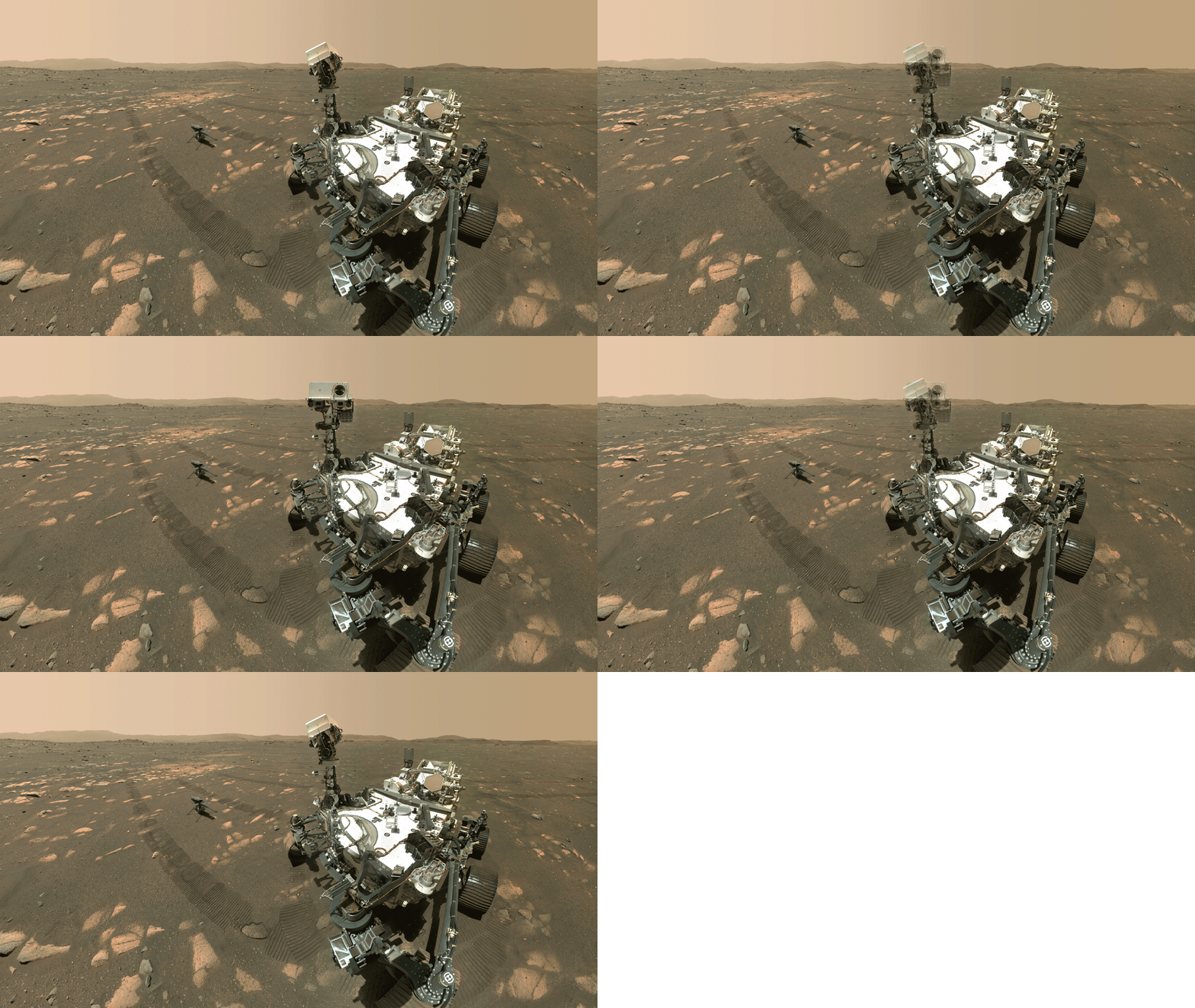
The Mars 2020 mission comprises several key technological marvels. The Perseverance rover itself is a sophisticated mobile laboratory, equipped with seven scientific instruments designed for in-situ analysis and sample collection. Its advanced robotic arm can drill into Martian rock and soil, collecting core samples that are hermetically sealed for potential future return to Earth. A crucial component is the MOXIE instrument, which successfully demonstrated the ability to produce oxygen from the Martian atmosphere, a vital step for future human missions. Accompanying Perseverance was the Ingenuity helicopter, a small, autonomous rotorcraft designed to test powered flight in Mars' thin atmosphere. Ingenuity utilized a unique rotor system and advanced navigation to achieve multiple flights, proving the viability of aerial exploration on Mars.
📊 Key Facts & Numbers
The Mars 2020 mission achieved several significant numerical milestones. The mission was launched from Cape Canaveral Space Force Station aboard an Atlas V rocket. The journey to Mars spanned approximately seven months. The rover successfully landed in Jezero Crater. The Ingenuity helicopter operated for a period before its retirement on January 25, 2024, having completed flights.
👥 Key People & Organizations
Several key individuals and organizations were instrumental to the Mars 2020 mission. Thomas Zurbuchen, Associate Administrator for NASA's Science Mission Directorate, played a pivotal role in overseeing the mission's scientific objectives. Kathleen Stewart-Robson served as the mission's project manager at JPL, guiding its development and operations. Swati Mohan was the guidance, navigation, and control operations lead for the mission, famously announcing the landing confirmation. Bob Bapst was the lead engineer for the Ingenuity helicopter. The mission was a product of NASA's extensive network of centers and was supported by numerous contractors, including United Launch Alliance for the launch vehicle.
🌍 Cultural Impact & Influence
The Mars 2020 mission has profoundly impacted public perception and scientific discourse surrounding space exploration and the search for life beyond Earth. The dramatic landing of Perseverance, coupled with the groundbreaking flights of Ingenuity, captured global attention, inspiring a new generation of scientists and engineers. The mission's findings, such as the discovery of diverse organic molecules by the Curiosity rover in Gale Crater (though not directly part of Mars 2020, it informs the broader context), fuel public imagination about the possibility of past Martian life. The mission's success has also bolstered support for continued robotic and eventual human exploration of Mars, influencing popular culture through documentaries, news coverage, and educational outreach programs.
⚡ Current State & Latest Developments
As of mid-2024, the Mars 2020 mission continues its scientific investigations with the Perseverance rover actively exploring Jezero Crater. The rover is meticulously collecting and caching rock and soil samples, a critical step for the planned Mars Sample Return mission. Recent findings include detailed analyses of ancient river delta deposits, revealing complex geological histories and potential evidence of past water activity. The Ingenuity helicopter, though retired due to rotor damage sustained in January 2024, provided invaluable data on aerial reconnaissance capabilities, paving the way for future aerial explorers on Mars and other celestial bodies.
🤔 Controversies & Debates
While the Mars 2020 mission is widely celebrated, certain aspects have sparked debate. The immense cost, has led to discussions about resource allocation within NASA and the broader scientific community, with some arguing for increased investment in Earth-based research. The interpretation of potential biosignatures is subject to rigorous scientific scrutiny and debate. Furthermore, the long-term sustainability of sample return missions, requiring complex orbital rendezvous and Earth-based laboratory analysis, presents significant engineering and logistical hurdles that are still being addressed by the Mars Sample Return program.
🔮 Future Outlook & Predictions
The future outlook for the Mars 2020 mission is intrinsically linked to the success of the Mars Sample Return campaign. This ambitious multi-mission endeavor aims to bring the samples collected by Perseverance back to Earth for in-depth analysis in terrestrial laboratories, a process expected to take place in the early 2030s. Beyond sample return, the technologies demonstrated by Mars 2020, particularly the oxygen generation of MOXIE and the aerial capabilities of Ingenuity, are foundational for future human missions to Mars. Scientists anticipate that the data gathered will refine our understanding of Martian geology, climate history, and the potential for habitability, guiding subsequent exploration efforts.
💡 Practical Applications
The Mars 2020 mission's practical applications extend far beyond pure scientific discovery. The development of advanced robotics, autonomous navigation systems, and miniaturized scientific instruments for the Perseverance rover has direct spin-offs for terrestrial applications, including disaster response, deep-sea exploration, and advanced manufacturing. The MOXIE experiment, demonstrating oxygen production from carbon dioxide, holds significant implications for in-situ resource utilization (ISRU) for future human settlements on Mars, reducing reliance on Earth-based resupply. The lessons learned from operating complex machinery in extreme environments also inform the design of ruggedized equipment for challenging conditions on Earth, from polar research to mining operations.
Key Facts
- Category
- science
- Type
- topic