
Contents
Overview
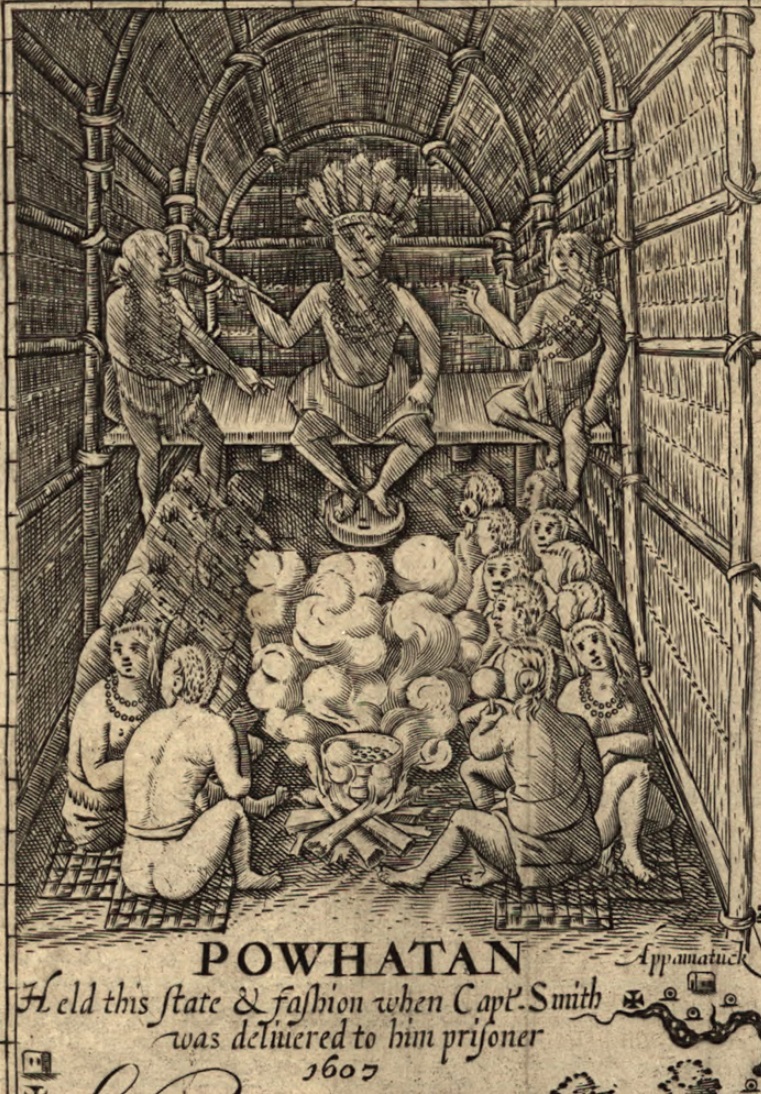
The Powhatan Confederacy's origins are rooted in the complex sociopolitical landscape of eastern Virginia long before European arrival. While the exact timeline of its formation is debated, the consolidation of power under Chief Wahunsenacawh (c. 1545–c. 1618) occurred in the late 16th and early 17th centuries, marking its emergence as a unified paramount chiefdom. Chief Wahunsenacawh inherited leadership of the Powhatan tribe and, through a combination of strategic marriages, diplomatic alliances, and military campaigns, subjugated or incorporated roughly 30 other Algonquian-speaking groups into his domain, which they called Tsenacommacah. This process wasn't a static creation but an ongoing assertion of authority, with tributary tribes maintaining their own leadership structures but owing allegiance and tribute to the paramount chief. The arrival of the english-colonists in 1607 at Jamestown immediately thrust the Confederacy into a new, unprecedented era of interaction, fundamentally altering its internal dynamics and external relations, a process documented by figures like Captain John Smith.
⚙️ How It Works
The Confederacy operated as a hierarchical political entity, with the mamanatowick at its apex. This paramount chief held significant authority, demanding tribute in the form of goods, food, and labor from the subordinate tribes, each led by a weroance. The weroances were responsible for managing their own territories and people but were bound to support the paramount chief, especially in times of war or during large ceremonial gatherings. This structure allowed for a unified front against external threats, a crucial factor when facing the encroaching English colonists. The Confederacy's economy was largely agrarian, supplemented by hunting, fishing, and gathering, with sophisticated agricultural practices that sustained a significant population. Their governance, while centralized under the paramount chief, also relied on the cooperation and loyalty of the individual tribal leaders, creating a dynamic balance of power.
📊 Key Facts & Numbers
At its peak in 1607, the Powhatan Confederacy encompassed an estimated 14,000 to 21,000 individuals spread across approximately 200 villages within Tsenacommacah. This territory stretched across much of eastern Virginia, from the Potomac River to the Rappahannock River and south to the James River. The Confederacy was composed of roughly 30 distinct tribes, including the Powhatan, Pamunkey, Mattaponi, and Chickahominy. The Confederacy's military strength was estimated to be around 2,000 warriors, capable of mobilizing quickly to defend their lands. By 1669, following decades of conflict and disease, the Confederacy's population had drastically declined to an estimated 1,800 individuals, a stark testament to the devastating impact of colonization.
👥 Key People & Organizations
The most prominent figure associated with the Confederacy is Chief Wahunsenacawh (c. 1545–c. 1618), who was the mamanatowick that consolidated the tribes into the paramount chiefdom. Chief Wahunsenacawh inherited leadership of the Powhatan tribe. His daughter, Pocahontas, became a significant figure in Anglo-Native relations, famously interacting with Captain John Smith and later marrying John Rolfe, an English colonist. After Wahunsenacawh's death in 1618, his brother, Opechancanough, succeeded him and led major uprisings against the English in 1622 and 1644. The Jamestown Colony itself, established by the Virginia Company of London, was the primary European entity with which the Confederacy interacted, leading to figures like Lord De La Warr playing crucial roles in the colonial administration and military campaigns against the Powhatan people.
🌍 Cultural Impact & Influence
The Powhatan Confederacy's existence and its interactions with the English colonists profoundly shaped the early history of North America. The initial encounters at Jamestown were characterized by a complex mix of trade, diplomacy, and escalating conflict, famously documented in the writings of Captain John Smith. The Confederacy's resistance, particularly the uprising of 1622 led by Opechancanough, significantly impacted colonial policy and led to the Crown taking direct control of Virginia in 1624. The story of Pocahontas and her relationship with John Rolfe became a foundational narrative in American folklore, albeit often romanticized and detached from the harsh realities of colonial expansion. The Confederacy's struggle for survival against disease, warfare, and land encroachment also serves as a critical case study in the devastating impact of European colonization on Indigenous populations.
⚡ Current State & Latest Developments
Today, the descendants of the Powhatan Confederacy continue to thrive and maintain their cultural identity. Several tribes in Virginia, including the Pamunkey, Mattaponi, Upper Mattaponi, Chickahominy, and Eastern Chickahominy, are federally or state-recognized. These tribes actively work to preserve their languages, traditions, and histories, often engaging in cultural revitalization programs and advocating for Indigenous rights. The ongoing efforts to reclaim and teach the Powhatan language and to educate the public about the Confederacy's history are crucial developments in ensuring its legacy endures beyond the colonial narrative. The Virginia Museum of Native American History plays a role in this contemporary engagement.
🤔 Controversies & Debates
The historical narrative of the Powhatan Confederacy is fraught with controversy, largely stemming from the colonial perspective that dominated early documentation. The portrayal of Pocahontas has been particularly contentious, often romanticized into a figure who single-handedly brokered peace, obscuring the broader political and military struggles. The motivations and actions of both the Powhatan people and the English colonists are subject to ongoing scholarly debate, with historians continually re-examining primary sources to offer more nuanced interpretations. The question of how to accurately represent the Confederacy's complex political structure and its eventual decline, without resorting to simplistic victimhood or heroic resistance narratives, remains a central challenge in historical scholarship and public understanding. The legacy of Opechancanough's resistance is also debated, with some viewing it as a desperate act of defense and others as a catalyst for further colonial retribution.
🔮 Future Outlook & Predictions
The future of the Powhatan Confederacy's legacy lies in the continued resilience and self-determination of its descendant tribes. As these communities grow and advocate for their rights, their influence on historical interpretation and public policy is likely to increase. Efforts to revitalize the Powhatan language and traditional practices hold the potential for a cultural renaissance, reconnecting younger generations with their heritage. Furthermore, as the understanding of Indigenous history becomes more central to the American narrative, the story of the Powhatan Confederacy will likely be told with greater accuracy and depth, challenging colonial-centric viewpoints. The ongoing process of repatriation of Indigenous artifacts and ancestral remains also points to a future where Indigenous peoples have greater control over their own histories and cultural patrimony.
💡 Practical Applications
While the Powhatan Confederacy as a political entity ceased to exist in its original form, its legacy has practical applications in understanding historical dynamics and contemporary Indigenous affairs. The study of its governance and diplomacy provides valuable insights into intercultural communication and conflict reso
Key Facts
- Category
- history
- Type
- topic