
Contents
- 🌎 Introduction to Replacement Rate
- 📊 Understanding Total Fertility Rate (TFR)
- 👥 The Impact of Replacement Rate on Population Growth
- 🚨 Consequences of Low Replacement Rate
- 📈 Factors Influencing Replacement Rate
- 🌍 Global Replacement Rate Trends
- 👴 Aging Population and Replacement Rate
- 🤝 Immigration and Replacement Rate
- 📊 Calculating Replacement Rate
- 🔮 Future of Replacement Rate and Population Growth
- Frequently Asked Questions
- Related Topics
Overview
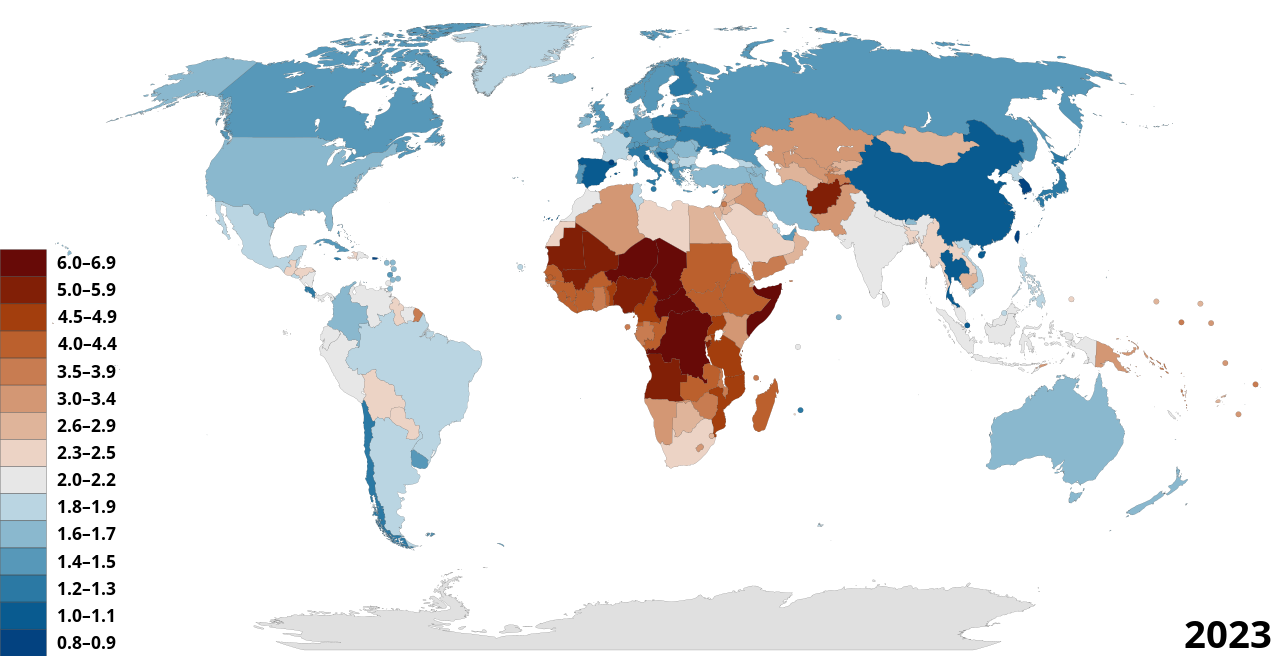
The replacement rate, approximately 2.1 children per woman, is the average number of children a woman would need to have to replace herself and her partner, ensuring a stable population. This rate is crucial in understanding population growth, as it directly affects the size and structure of a population. Historically, replacement rates have varied significantly across different regions and cultures, with some countries experiencing extremely low rates, such as Japan with a rate of 1.4, while others, like Niger, have high rates of 7.2. The World Health Organization and demographers closely monitor these rates, as they have significant implications for healthcare, education, and economic systems. The impact of declining replacement rates is a topic of intense debate, with some arguing it leads to aging populations and increased burden on social security systems, while others see it as an opportunity for increased investment in human capital. As the global population continues to evolve, understanding replacement rates will be essential in navigating the complexities of population growth and development, with the United Nations projecting significant shifts in population structures by 2050.
🌎 Introduction to Replacement Rate
The concept of replacement rate is crucial in understanding population growth and demographics. It refers to the average number of children a woman would need to have in her lifetime to replace herself and her partner, thereby maintaining a stable population size. This is closely related to the Total Fertility Rate (TFR), which is the average number of children born to a woman over her lifetime. The replacement rate is essential for population growth and demographic studies. According to the United Nations, a replacement rate of 2.1 children per woman is required to maintain a stable population size. The World Bank also provides data on replacement rates and fertility rates across different countries.
📊 Understanding Total Fertility Rate (TFR)
The Total Fertility Rate (TFR) is a key indicator of replacement rate. It is calculated by summing up the age-specific fertility rates (ASFRs) of a population. The TFR takes into account the number of children born to women of different ages and assumes that the current fertility rates will remain constant over time. A TFR of 2.1 is generally considered the replacement rate, as it replaces the mother and father and accounts for mortality rates. The World Health Organization provides guidance on calculating TFR and replacement rate. The European Commission also monitors TFR and population trends in European countries.
👥 The Impact of Replacement Rate on Population Growth
The replacement rate has a significant impact on population growth. A rate above 2.1 indicates a growing population, while a rate below 2.1 indicates a declining population. Many countries, including Japan and Italy, are experiencing low replacement rates, which can lead to aging populations and labor shortages. On the other hand, countries with high replacement rates, such as Nigeria and India, are experiencing rapid population growth. The International Monetary Fund provides analysis on the economic implications of replacement rates and population growth. The United States Census Bureau also tracks population trends and replacement rates in the United States.
🚨 Consequences of Low Replacement Rate
Low replacement rates can have severe consequences on a country's economy and social security systems. With a declining population, there are fewer working-age individuals to support the pension systems and healthcare systems. This can lead to increased taxes and reduced benefits for the elderly. Additionally, low replacement rates can result in labor shortages and reduced economic growth. The Organisation for Economic Co-operation and Development provides recommendations on addressing low replacement rates and aging populations. The European Union also implements policies to address demographic challenges and replacement rates.
📈 Factors Influencing Replacement Rate
Several factors influence replacement rates, including education, urbanization, and family planning. Women with higher levels of education tend to have fewer children, while urbanization can lead to changes in family structures and fertility rates. Government policies, such as family benefits and parental leave, can also impact replacement rates. The United Nations Development Programme provides guidance on implementing policies to support replacement rates and population growth. The World Bank also offers analysis on the impact of education and urbanization on replacement rates.
🌍 Global Replacement Rate Trends
Global replacement rate trends vary significantly. Some countries, such as South Korea and Hong Kong, have extremely low replacement rates, while others, such as Somalia and Afghanistan, have high replacement rates. The United Nations provides data on replacement rates and fertility rates across different countries. The World Health Organization also monitors global health trends and replacement rates. The International Monetary Fund provides analysis on the economic implications of replacement rates and population growth.
👴 Aging Population and Replacement Rate
Aging populations are closely linked to replacement rates. As populations age, there are fewer working-age individuals to support the elderly, leading to increased taxes and reduced benefits. Immigration can help mitigate the effects of aging populations, but it is not a long-term solution. The Organisation for Economic Co-operation and Development provides recommendations on addressing aging populations and replacement rates. The European Union also implements policies to address demographic challenges and replacement rates. The United States Census Bureau tracks population trends and replacement rates in the United States.
🤝 Immigration and Replacement Rate
Immigration can have a significant impact on replacement rates. Immigrants tend to have higher fertility rates than the native population, which can help increase the replacement rate. However, immigration is not a long-term solution to low replacement rates, as the fertility rates of immigrants often decline over time. The United Nations provides data on international migration and replacement rates. The World Bank offers analysis on the impact of immigration on replacement rates and population growth. The European Commission monitors migration policies and replacement rates in European countries.
📊 Calculating Replacement Rate
Calculating replacement rates is a complex task, as it requires accurate data on fertility rates and mortality rates. The Total Fertility Rate (TFR) is a key indicator of replacement rate, but it does not take into account mortality rates. The United Nations provides guidance on calculating replacement rates and population growth. The World Health Organization also provides guidance on calculating TFR and replacement rate. The European Commission monitors TFR and population trends in European countries.
🔮 Future of Replacement Rate and Population Growth
The future of replacement rates and population growth is uncertain. While some countries are experiencing low replacement rates, others are experiencing rapid population growth. The United Nations provides projections on population growth and replacement rates. The World Bank offers analysis on the economic implications of replacement rates and population growth. The International Monetary Fund provides recommendations on addressing demographic challenges and replacement rates. As the world's population continues to grow, it is essential to monitor replacement rates and develop policies to address the challenges and opportunities that arise from demographic changes.
Key Facts
- Year
- 2020
- Origin
- United Nations Department of Economic and Social Affairs
- Category
- Demographics
- Type
- Demographic Concept
Frequently Asked Questions
What is the replacement rate?
The replacement rate is the average number of children a woman would need to have in her lifetime to replace herself and her partner, thereby maintaining a stable population size. It is closely related to the Total Fertility Rate (TFR), which is the average number of children born to a woman over her lifetime. A replacement rate of 2.1 children per woman is generally considered the replacement rate, as it replaces the mother and father and accounts for mortality rates. The United Nations provides data on replacement rates and fertility rates across different countries.
Why is the replacement rate important?
The replacement rate is essential for population growth and demographic studies. A low replacement rate can lead to aging populations and labor shortages, while a high replacement rate can lead to rapid population growth. The Organisation for Economic Co-operation and Development provides recommendations on addressing low replacement rates and aging populations. The European Union also implements policies to address demographic challenges and replacement rates.
What factors influence replacement rates?
Several factors influence replacement rates, including education, urbanization, and family planning. Women with higher levels of education tend to have fewer children, while urbanization can lead to changes in family structures and fertility rates. Government policies, such as family benefits and parental leave, can also impact replacement rates. The United Nations Development Programme provides guidance on implementing policies to support replacement rates and population growth.
How is the replacement rate calculated?
The replacement rate is calculated using the Total Fertility Rate (TFR), which is the average number of children born to a woman over her lifetime. The TFR takes into account the number of children born to women of different ages and assumes that the current fertility rates will remain constant over time. The United Nations provides guidance on calculating replacement rates and population growth. The World Health Organization also provides guidance on calculating TFR and replacement rate.
What are the consequences of low replacement rates?
Low replacement rates can have severe consequences on a country's economy and social security systems. With a declining population, there are fewer working-age individuals to support the pension systems and healthcare systems. This can lead to increased taxes and reduced benefits for the elderly. Additionally, low replacement rates can result in labor shortages and reduced economic growth. The Organisation for Economic Co-operation and Development provides recommendations on addressing low replacement rates and aging populations.
Can immigration help mitigate the effects of low replacement rates?
Immigration can help mitigate the effects of low replacement rates, but it is not a long-term solution. Immigrants tend to have higher fertility rates than the native population, which can help increase the replacement rate. However, the fertility rates of immigrants often decline over time. The United Nations provides data on international migration and replacement rates. The World Bank offers analysis on the impact of immigration on replacement rates and population growth.
What is the current replacement rate in the world?
The current replacement rate varies significantly across different countries. According to the United Nations, the total fertility rate (TFR) for the world is approximately 2.4 children per woman. However, this number is declining, and many countries are experiencing low replacement rates. The World Health Organization provides guidance on calculating TFR and replacement rate. The European Commission monitors TFR and population trends in European countries.