
Contents
Overview
The genesis of the Royal Marines can be traced to 28 October 1664, with the formation of the Duke of York and Albany's maritime regiment of Foot. This unit was established to provide a disciplined land force for naval service, a concept that would define the corps for centuries. The designation 'Royal' was first conferred in 1755, acknowledging their long-standing service to the Crown. A pivotal moment in their modern identity arrived on 14 February 1942, with the establishment of the first Royal Marine Commando unit at Deal, Kent, marking the formalization of their elite commando role. This evolution from a maritime regiment to a specialized commando force reflects the changing nature of warfare, particularly the demands of amphibious operations and rapid deployment, a legacy built upon by units like the Special Boat Service and the Royal Navy itself.
⚙️ How It Works
At its core, the Royal Marines operate as a highly integrated amphibious infantry force, designed for rapid deployment from the sea. Their operational capability hinges on specialized training at the Commando Training Centre Royal Marines (CTCRM) in Lympstone, Devon, where recruits undergo the demanding '32 weeks of hell' to earn the coveted green beret. This training instills a commando ethos focused on physical fitness, mental resilience, and the ability to conduct complex operations in diverse environments, from Arctic conditions to desert terrains. They are equipped to conduct a wide spectrum of missions, including amphibious assaults, counter-terrorism operations, and providing support to United Kingdom Special Forces through the Special Forces Support Group (SFSG). Their operational readiness is maintained through continuous exercises, often in partnership with allied forces like the United States Marine Corps.
📊 Key Facts & Numbers
The Royal Marines, as a component of the Royal Navy, operate with a distinct identity and capability. While exact troop numbers fluctuate, the active strength is typically around 6,500 personnel, with a further 750 in the Royal Marines Reserve. The Commando Training Centre Royal Marines trains approximately 1,000 new recruits annually, a figure that underscores the continuous demand for these elite soldiers. The Royal Marines Band Service, comprising around 130 musicians, performs at over 1,000 engagements each year, from state ceremonies to public concerts, generating significant public engagement. Their operational reach is global, with deployments often involving naval assets like the HMS Bulwark or HMS Albion, which are specifically designed to support amphibious operations.
👥 Key People & Organizations
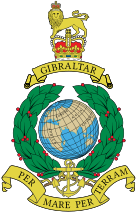
Key figures and organizations are intrinsically linked to the Royal Marines' enduring legacy. The 'Duke of York and Albany's maritime regiment of Foot,' established in 1664, is the foundational entity. King George IV's 1827 decree bestowing the 'Great Globe itself' as their emblem highlights the monarch's role in shaping their identity. More recently, the Commando Training Centre Royal Marines (CTCRM) serves as the crucible for new recruits, while the 3 Commando Brigade is the primary operational formation. The Royal Navy acts as the parent organization, providing strategic direction and logistical support. The Special Boat Service (SBS), often drawing personnel from the Royal Marines, represents a highly specialized maritime counter-terrorism and special reconnaissance capability.
🌍 Cultural Impact & Influence
The cultural resonance of the Royal Marines is profound, deeply embedded in British military lore and popular imagination. Their iconic green beret and the 'Per Mare, Per Terram' (By Sea, By Land) motto are instantly recognizable symbols of martial prowess. The 'Great Globe itself' emblem, a unique honour, speaks to their historical global reach and service. The Royal Marines Band Service, with its frequent public performances and recordings, further disseminates their presence, contributing to a national sense of pride. Their commando spirit has inspired numerous books, films, and documentaries, solidifying their image as elite warriors capable of overcoming any obstacle, a narrative often contrasted with the more conventional roles of other British Army units.
⚡ Current State & Latest Developments
In the current operational landscape of 2024-2025, the Royal Marines are undergoing significant adaptation under the Future Commando Force (FCF) initiative. This strategy aims to transform the corps into a more agile, adaptable, and globally deployable force, capable of operating in contested littoral environments. Key developments include increased integration with the Royal Navy's surface fleet, enhanced capabilities in cyber and electronic warfare, and a greater emphasis on operating in smaller, more dispersed units. The 3 Commando Brigade is at the forefront of these changes, with exercises like 'Arctic Arrow' and 'Green Blade' testing new operational concepts. The FCF strategy signals a deliberate pivot towards peer-state competition and the challenges of future warfare, moving beyond traditional counter-insurgency roles.
🤔 Controversies & Debates
The Royal Marines are not without their controversies and debates, particularly concerning their role and resourcing within the broader defence structure. The Future Commando Force (FCF) initiative, while lauded by many, has also faced scrutiny regarding its long-term funding and the potential impact on traditional commando capabilities. Some critics argue that the emphasis on littoral operations and integration with the naval fleet might dilute the force's independent expeditionary capacity. Furthermore, debates periodically arise regarding the optimal size and structure of the Royal Marines relative to the evolving threats and the defence budget. The integration of personnel into roles supporting the Special Forces Support Group also raises questions about the distinct identity and operational focus of the commando force.
🔮 Future Outlook & Predictions
The future trajectory of the Royal Marines is intrinsically tied to the success of the Future Commando Force (FCF) strategy. Projections suggest a continued evolution towards a more technologically advanced, networked, and globally responsive force. This will likely involve greater reliance on autonomous systems, advanced intelligence, surveillance, and reconnaissance (ISR) capabilities, and enhanced cyber warfare integration. The corps is expected to play an increasingly crucial role in projecting power from the sea, particularly in the Indo-Pacific region and the Arctic. Expert forecasts indicate a sustained demand for their unique amphibious and commando skills, positioning them as a critical asset in addressing future geopolitical challenges and maintaining Britain's global influence.
💡 Practical Applications
The practical applications of Royal Marines expertise are diverse and critical to national security. Their primary role involves conducting amphibious assaults, securing beachheads, and establishing forward operating bases from naval vessels, a capability vital for power projection. They are also deployed for maritime security operations, including counter-piracy and counter-terrorism missions in volatile regions. The Royal Marines provide a significant component of the Special Forces Support Group, offering specialized support to UKSF operations. Furthermore, their highly trained personnel are frequently called upon for non-combat roles, such as disaster relief and humanitarian aid in crisis zones, demonstrating their versatility beyond direct combat.
Key Facts
- Category
- military
- Type
- topic