
Contents
Overview
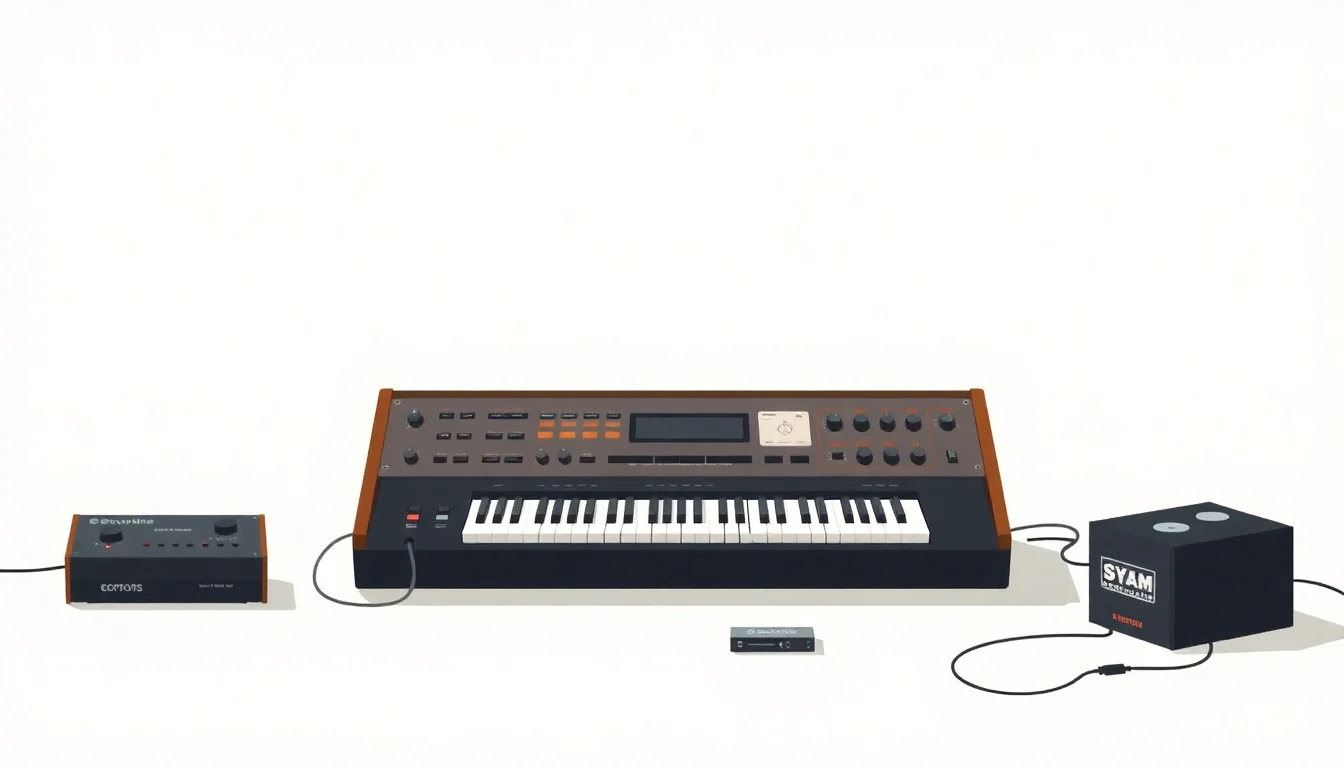
The story of Sequential Circuits begins in 1974, when Dave Smith, a visionary engineer, founded the company in Santa Clara, California. Smith's early work was driven by a desire to create synthesizers that offered greater flexibility and sonic possibilities than the monophonic instruments of the era. Precursors to Sequential's major innovations can be traced to Smith's earlier projects, including the EVP (Electronic Voltage Processor) and the Model 8 analog synthesizer. The company's breakthrough arrived in 1978 with the release of the Prophet-5, a revolutionary instrument that allowed musicians to store and recall multiple sound patches, a feature previously unheard of in polyphonic synthesizers. This innovation, coupled with its distinctive sound, quickly made the Prophet-5 an indispensable tool for artists across genres, from progressive rock to new wave and film scores. The company's commitment to advancing electronic music technology continued with the development of the MIDI protocol, a standard that would fundamentally change how electronic instruments communicated.
⚙️ How It Works
Sequential Circuits' instruments, particularly the Prophet-5 and its successors like the Prophet-6 and Prophet-10, operate on the principles of subtractive synthesis. This involves generating complex waveforms from simple oscillators and then shaping them using filters and amplifiers. The key innovation that set Sequential apart was its use of microprocessors, notably the Intel 8080, to control various parameters. This allowed for programmability, meaning users could save their custom sounds (patches) and recall them later, a stark contrast to the fixed-sound architecture of earlier analog synthesizers. The MIDI protocol, reportedly co-developed by Dave Smith and Chester Cannon among others, enabled different electronic instruments, sequencers, and computers to communicate with each other, synchronizing tempo, note information, and control data, effectively creating a universal language for electronic music.
📊 Key Facts & Numbers
Sequential Circuits' impact is quantifiable. The Prophet-5 synthesizer, released in 1978, is estimated to have sold over 6,000 units during its production run, a significant number for a high-end instrument at the time. The MIDI protocol, standardized in 1983, is now implemented in over 100 million devices worldwide. The company's instruments have been featured on an estimated 90% of popular music released in the early 1980s. Despite Sequential Circuits filing for bankruptcy in 1987, its instruments continue to command high prices on the used market, with some Prophet-5 units selling for upwards of $10,000 USD. The re-established Sequential brand, under Focusrite ownership since 2021, continues to produce high-end analog synthesizers, with new models like the Take-5 retailing for around $2,000 USD.
👥 Key People & Organizations
The undisputed central figure of Sequential Circuits is its founder, Dave Smith (1950-2022). Smith was an engineer and entrepreneur whose vision drove the company's innovations. He was instrumental in the design of the Prophet-5 and a key architect of the MIDI specification. Following the original company's demise, Smith founded Dave Smith Instruments in 2002, which later rebranded as Sequential in 2018. Other key figures involved in the development of MIDI include Chester Cannon and Masahiro Ikegami. In 2021, Focusrite, a British audio technology company, acquired Sequential, bringing the brand under the umbrella of a larger, established audio manufacturer. Yamaha acquired the original Sequential Circuits assets in 1987.
🌍 Cultural Impact & Influence
The cultural resonance of Sequential Circuits' instruments is immense. The distinctive sound of the Prophet-5 became synonymous with the sound of the 1980s, gracing iconic tracks by artists such as Madonna ('Like a Prayer'), Michael Jackson ('Billie Jean'), and Stevie Wonder. Its influence extended to film scores, notably in Vangelis' work for 'Blade Runner'. The development of MIDI by Smith and his contemporaries democratized electronic music production, allowing for greater collaboration and complexity in musical arrangements. This technological leap enabled the rise of genres like EDM and hip-hop, where synthesized sounds and sequenced patterns are fundamental. The enduring appeal of Sequential's analog sound has also fueled a resurgence in analog synthesis, influencing a new generation of musicians and producers.
⚡ Current State & Latest Developments
As of 2024, the brand Sequential continues to thrive under the ownership of Focusrite. The company recently launched the Take-5, a compact polyphonic analog synthesizer that builds upon the legacy of the Prophet series. Dave Smith remained actively involved in product development until his passing in May 2022, leaving behind a robust pipeline of innovative instruments. The focus remains on producing high-quality analog synthesizers that blend classic sounds with modern features, catering to both seasoned professionals and aspiring musicians. The company's commitment to analog circuitry and user-friendly interfaces, exemplified by instruments like the OB-6 (co-developed with Oberheim) and the Prophet Rev2, signals a continued dedication to its core principles.
🤔 Controversies & Debates
One of the most significant controversies surrounding Sequential Circuits involves the intense competition and legal disputes that arose in the early days of synthesizer development. While Dave Smith was a pioneer, other companies like Korg and Roland were also rapidly innovating, leading to debates over patent infringements and feature parity. The bankruptcy of the original Sequential Circuits in 1987 also sparked discussions about the financial viability of boutique synthesizer manufacturers in a market increasingly dominated by larger corporations like Yamaha. Furthermore, the ongoing debate within the music production community centers on the inherent value of analog versus digital synthesis; while Sequential champions analog warmth, digital synthesis offers unparalleled precision and sonic variety, leading to differing preferences among musicians and producers.
🔮 Future Outlook & Predictions
The future of Sequential appears robust, bolstered by its acquisition by Focusrite and the continued demand for high-quality analog synthesizers. We can anticipate further innovations that marry classic analog sound design with contemporary digital control and connectivity, potentially exploring new forms of polyphonic synthesis and integration with modern digital audio workstations. The legacy of Dave Smith will undoubtedly continue to inspire new instrument designs, possibly revisiting iconic architectures with updated features. There's also potential for Sequential to expand its reach into more accessible price points, broadening its user base without compromising its sonic integrity. The ongoing resurgence of analog hardware in music production suggests a sustained market for Sequential's offerings for at least the next decade.
💡 Practical Applications
The primary application of Sequential Circuits' technology lies squarely within the realm of music creation and performance. Their synthesizers, from the iconic Prophet-5 to modern iterations like the Prophet Rev2, are used by musicians, composers, and producers to generate a vast array of sounds for songs, film scores, and sound design. The MIDI protocol, a direct descendant of Sequential's pioneering work, is ubiquitous in music studios worldwide, enabling the synchronization of keyboards, drum machines, sequencers, and computer-based digital audio workstations (DAWs) like Ableton Live and Logic Pro. This allows for intricate arrangements, complex automation
Key Facts
- Category
- technology
- Type
- topic