
Contents
Overview
The Tirpitz was a strategic deterrent, largely confined to Norwegian waters, where she was a constant target for Allied air and naval forces. Her operational history was marked by a series of damaging raids and ultimately, her destruction. Grand Admiral Alfred von Tirpitz was the driving force behind the Imperial German Navy. The Tirpitz was heavier than her sister ship, the Bismarck. The Tirpitz's existence was a constant concern for Allied convoys heading to the Soviet Union. The wreck of the Tirpitz lay on the seabed for decades after her sinking.
🎵 Origins & History
The genesis of the Tirpitz lies in Germany's ambitious naval expansion under Adolf Hitler, aiming to challenge the dominance of the Royal Navy. As a powerful surface raider, she embodied the naval theories of Alfred von Tirpitz, whose name she proudly bore, symbolizing a continuation of Germany's imperial naval aspirations.
⚙️ How It Works
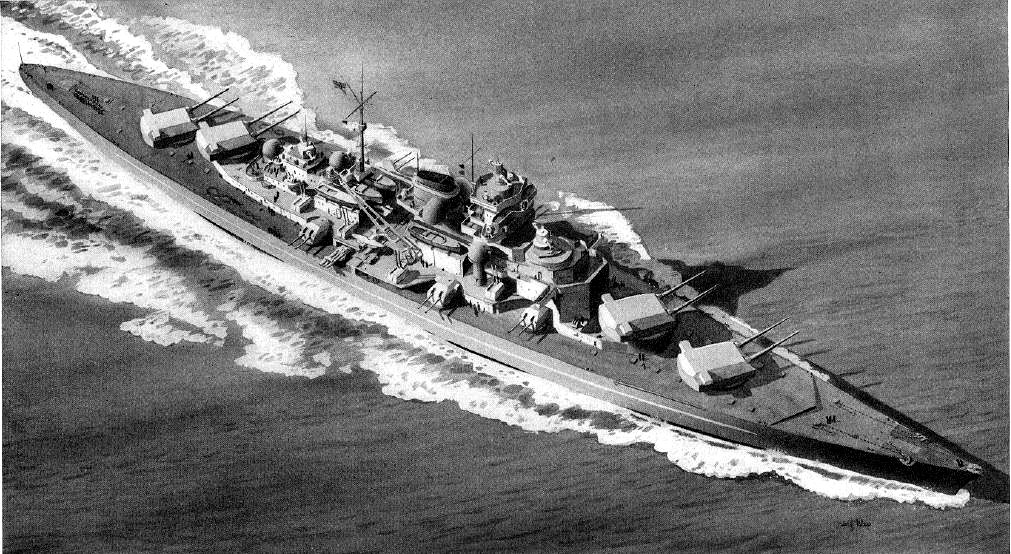
As a battleship, the Tirpitz was engineered for immense firepower and survivability. Her main armament consisted of eight 38 cm (15 in) guns. Secondary armament included twelve 15 cm (5.9 in) guns, sixteen 10.5 cm (4.1 in) guns, and numerous smaller anti-aircraft weapons. Her propulsion system comprised 12 Wagner high-pressure boilers and three Blohm & Voss geared steam turbines, driving three shafts and providing a top speed of approximately 30.8 knots (57.0 km/h; 35.4 mph). The ship's armor scheme was extensive, with a main belt of 320 mm (13 in) and a deck armor of up to 120 mm (4.7 in), designed to withstand heavy shellfire and torpedo attacks.
📊 Key Facts & Numbers
The Tirpitz was a behemoth of naval engineering, displacing approximately 42,900 tonnes (42,200 long tons) fully loaded, making her the heaviest battleship ever constructed by a European navy. Her sister ship, the Bismarck, displaced slightly less. The Tirpitz measured 251 meters (823 ft 6 in) in length and had a beam of 36 meters (118 ft 1 in). During her operational life, she required a crew of 2,600 officers and men. Her eight 38 cm guns had a maximum range of 36,400 meters (39,800 yd). The ship was sunk on November 12, 1944, with an estimated 1,000 crew members perishing out of the approximately 2,000 on board at the time.
👥 Key People & Organizations
Key figures associated with the Tirpitz include Grand Admiral Alfred von Tirpitz, after whom the ship was named, a pivotal architect of German naval power. Admiral Erich Raeder, Commander-in-Chief of the Kriegsmarine during much of her construction and early service, championed the construction of such capital ships. Kapitän zur See Otto Ciliax was her first commanding officer. Later commanders included Kapitän zur See Wolfgang Lützow and Kapitän zur See Hans Meyer. The ship's ultimate destruction was orchestrated by the Royal Air Force (RAF) and Fleet Air Arm of the Royal Navy, notably through operations like Operation Catechism.
🌍 Cultural Impact & Influence
The Tirpitz, despite limited combat sorties, cast a long shadow over Allied naval strategy during World War II. Her mere presence in Norwegian waters forced the Allies to divert significant resources—ships, aircraft, and personnel—to counter her perceived threat, particularly to protect the vital Murmansk convoys supplying the Soviet Union. Her operational history became a case study in the strategic deployment of capital ships in the face of overwhelming air power and specialized anti-ship weaponry. The legend of the Tirpitz, a powerful but ultimately vulnerable leviathan, has endured in naval history and popular culture, often depicted as a symbol of Germany's grand but ultimately doomed naval ambitions.
⚡ Current State & Latest Developments
Following her sinking on November 12, 1944, in Tromsø, Norway, the wreck of the Tirpitz lay on the seabed for decades. Salvage operations began in the 1950s, with much of her metal being recovered for reuse. Today, remnants of the ship, including parts of her massive gun turrets and hull, can still be found in the waters off Tromsø. The site is a popular destination for divers and naval history enthusiasts. The story of her final moments, a dramatic aerial assault by British bombers, continues to be studied in military history circles as a testament to the evolving nature of naval warfare in the Second World War era.
🤔 Controversies & Debates
The strategic deployment of the Tirpitz is a subject of ongoing debate among naval historians. Critics argue that her immense cost and limited operational effectiveness represented a misallocation of resources that could have been better used for U-boat construction or other war efforts. Proponents contend that her deterrent value, forcing the Allies to commit substantial forces to neutralize her, was a significant strategic achievement in itself. The effectiveness of Allied operations against her, particularly the use of chariot-class midget submarines and heavy bombers, is also debated, with some arguing for their ingenuity and others highlighting the immense effort and risk involved in finally sinking the behemoth.
🔮 Future Outlook & Predictions
The future of the Tirpitz wreck involves ongoing preservation efforts and continued interest from maritime archaeologists and historians. While major salvage operations concluded decades ago, the site remains a significant underwater monument. Future research may focus on further understanding the environmental impact of the wreck and its long-term stability. The narrative of the Tirpitz also continues to inspire fictional works and documentaries, ensuring her story remains relevant in discussions about naval power, technological arms races, and the dramatic theaters of World War II.
💡 Practical Applications
The primary 'application' of the Tirpitz was as a surface raider and a strategic deterrent. Her existence compelled the Royal Navy to dedicate significant naval assets, including aircraft carriers and battleships, to hunting her down or containing her threat, thereby diverting resources from other theaters of war. Her presence in Norway was a constant concern for Allied convoys heading to the Soviet Union, necessitating escort fleets that could engage her if she broke out into the Atlantic. While she saw limited direct combat, her strategic utility as a 'fleet in being' was her most significant, albeit costly, application.
Key Facts
- Category
- history
- Type
- event